


The first SEATO (1954–1977) was built to collectively defend its member nations. A proposed new Indo-Pacific Alliance for Collective Security and Trade (IPACT), could help defend the democratic nations of the Indo-Pacific and the trade, transportation and communications networks that connect them.
Rather than replacing the region's existing alliances and institutions, IPACT would provide a hub to consolidate their strengths and address their weaknesses, pooling resources and reducing overlap and unnecessary duplication, while increasing economic and strategic resilience.
↩️ Read Part 1 of the series: The Case for a Consolidated Indo-Pacific Alliance
💬 On Tuesday, September 1, I’ll host a live discussion for econVue+ subscribers on critical Indo-Pacific economic and security issues.
Join the live discussion →
The Price of Fragmentation
The allies in the Pacific share intelligence, conduct exercises, integrate weapons systems and are expanding defense-industrial cooperation. As discussed in Part 1, multiple existing organizations already perform or support some of these functions. Many countries are spending heavily on defense, including Japan, which had previously resisted such increases. Australia’s nuclear-powered submarine program under AUKUS is projected to cost A$268–368 billion over roughly three decades.1 China’s military buildup and expanding blue-water naval activity far from its shores have produced a distributed response across the region.
China spent $336 billion on its military in 2025. The United States, Japan, South Korea and Australia together spent approximately $1.1 trillion, more than three times as much.2 China's spending, however, is directed by one government, through one military and one strategic planning system. Allied spending is divided among separate governments, commands, procurement systems and strategic priorities. The question is not simply how much the region spends on security, but how efficiently that spending is converted into collective capability.
Fragmentation itself has a price, although the true cost of the Indo-Pacific’s overlapping institutions is surprisingly difficult to calculate.
Current costs of Indo-Pacific institutional architecture
APEC alone operates through four main committees and numerous working groups, expert groups and task groups. Its 2025 Secretariat budget was approximately S$9.6 million, while member governments also provide staff, host meetings and fund projects outside that budget. 3
The Pacific Islands Forum Secretariat and its Pacific Trade Invest offices spent approximately FJ$61.7 million in 2024 from general and trust funds. 4
Other important arrangements, including AUKUS and the Quad, do not have comparable standalone institutional budgets. Much of their cost is embedded within the defense, foreign-affairs and other ministries of participating governments.
The real cost of fragmentation, therefore, cannot be measured simply by adding up institutional budgets.
The human cost is just as important. Many of the same ministers, diplomats, military officers, business leaders, and policy experts circulate through these overlapping institutions and dialogues. Australia’s Richard Marles, discussed in Part 1, is a good example: as Deputy Prime Minister and Defence Minister, he moves among AUKUS, AUSMIN, bilateral defense relationships and the wider Indo-Pacific security network. Multiply that across governments, and fragmentation consumes the time and attention of the relatively small group of people responsible for making the system work.
Asia has achieved economies of scale in production without achieving economies of scale in security. In a recent essay in Foreign Affairs, Kurt Campbell and Rush Doshi argue that allies could become “co-creators of power,” pooling their capacity into what they call “allied scale”:5
❝ The Trump administration has called on allies to do more so that the United States can do less; in fact, in the future, both the allies and the United States will need to do more, creating two-way flows of capacity and interdependence that make the whole greater than the sum of its parts.
The problem, however, is not simply one of scale. It is a failure of architecture. How can the capacity Campbell and Doshi describe be converted into collective power? As I argued in Part 1, institutions must evolve with the economic and technological systems they govern.
The Search for Security in the Indo-Pacific
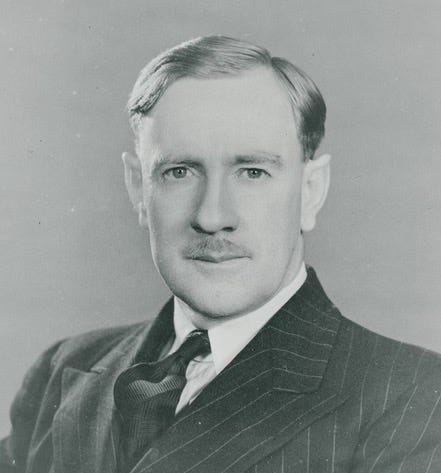
The quest for an effective and permanent security architecture in the Indo-Pacific dates back to the end of World War II. Australian Foreign Minister Percy Spender was an early advocate of Pacific collective security. Beginning in 1950, he pressed for a Pacific defense pact, and in 1951 helped negotiate what became ANZUS. He also envisioned a broader regional arrangement and explicitly looked to NATO as a model for Pacific security.6
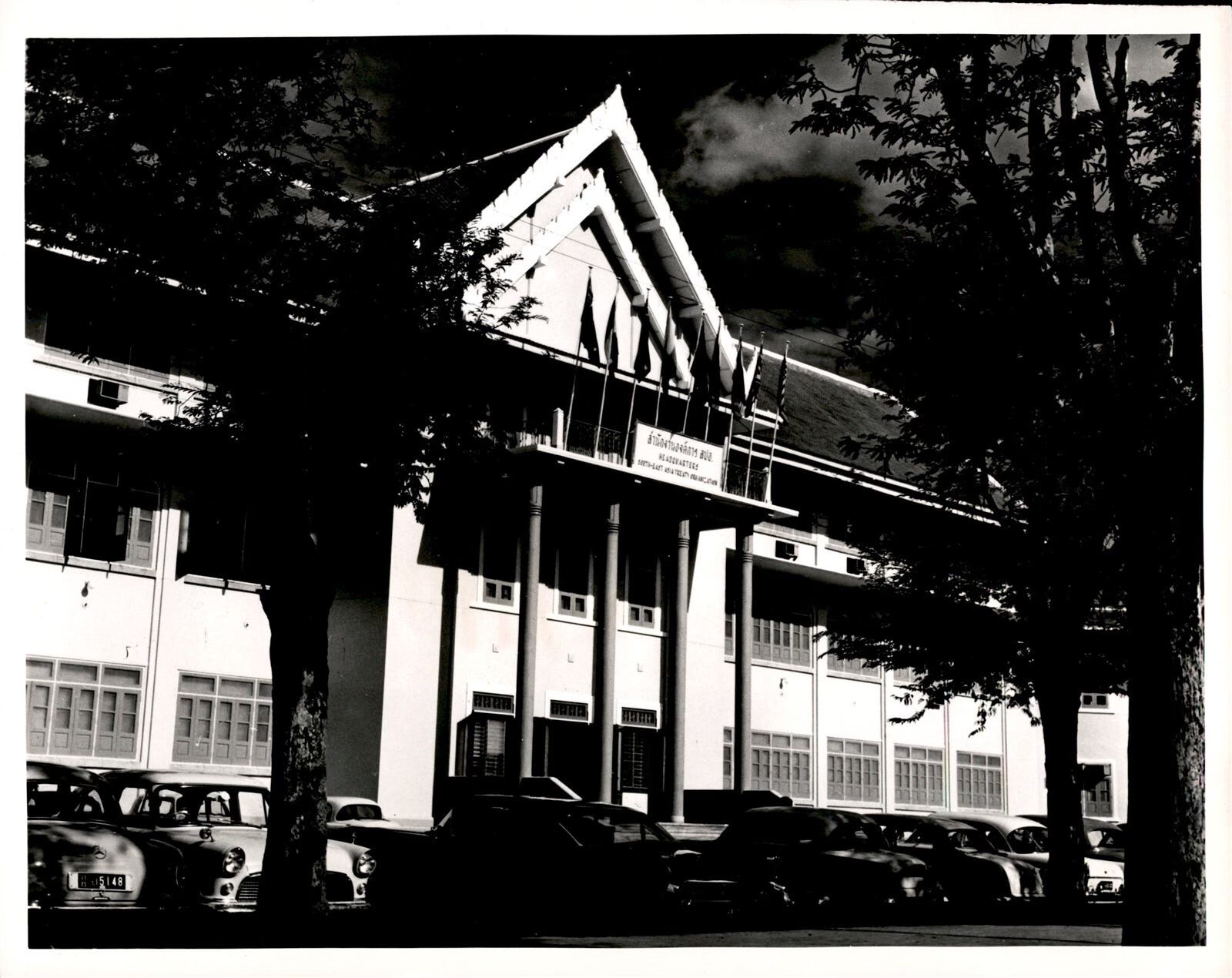
ANZUS and SEATO: Two Different Models
ANZUS — 1951
The Australia, New Zealand and United States Security Treaty created a three-country Pacific security relationship. It committed the parties to consult and to act in response to an armed attack in the Pacific, but it did not create a NATO-style integrated military organization or automatic Article 5 commitment.7
SEATO — 1954–1977
The Southeast Asia Treaty Organization grew out of the 1954 Manila Pact and eventually included eight members: Australia, France, New Zealand, Pakistan, the Philippines, Thailand, the United Kingdom and the United States. It was geographically broader than ANZUS but institutionally weak, with no standing forces or integrated military command.8
Nevertheless, SEATO sat atop an enormous reservoir of postwar military capacity. It eventually established a Military Planning Office in Bangkok and conducted joint exercises, but national forces remained under national control. As late as 1959, US planning explicitly stated that no standing SEATO command organization was required; a combined command would be assembled when necessary. 9
SEATO’s 1959–60 organizational budget was $896,860—roughly $10 million in today’s dollars. NATO’s 2026 common funding, by comparison, is approximately $6.2 billion. 10
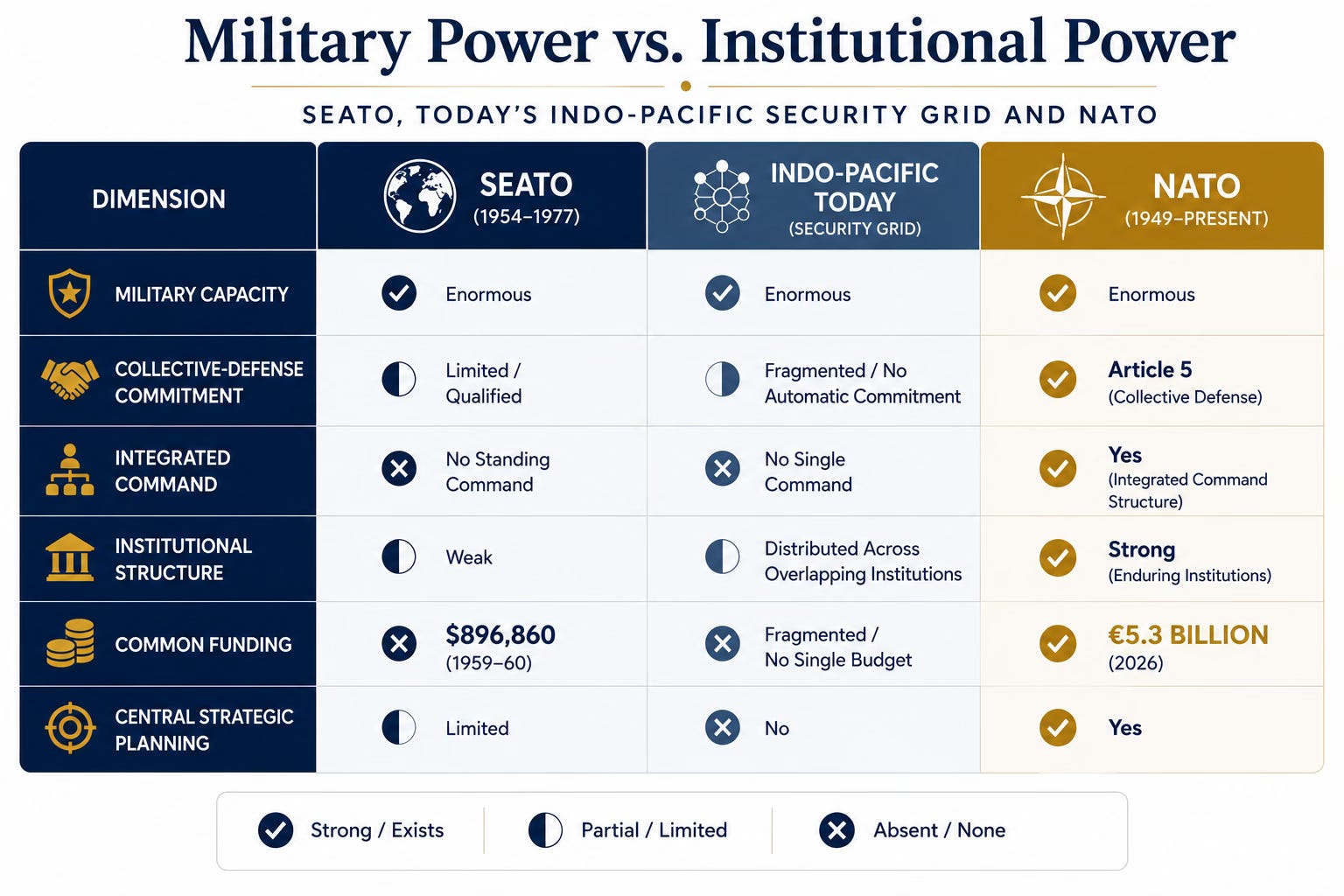
Why SEATO Failed
By the 1970s, these weaknesses had become terminal. Pakistan withdrew in 1973, France had largely disengaged, and in 1975, as the Vietnam War ended, the remaining members agreed to wind down the organization. SEATO formally ceased operations in 1977. 11
SEATO’s members did not agree sufficiently about what they were defending. Remarkably, few Southeast Asian countries actually belonged to the Southeast Asia Treaty Organization. Its members had divergent perceptions of both the threats they faced and their own strategic interests. SEATO’s enormous military capacity was weakly institutionalized among countries that lacked sufficient common purpose.
Would a Stronger SEATO Have Changed History?
It is impossible to know whether a more comprehensive SEATO could have changed the course of the conflicts that followed its creation. However, the purpose of collective defense is not primarily to win expensive wars, but to prevent them from happening in the first place. A credible commitment that an attack on one will bring a response from many, as with NATO, changes the expected cost of aggression.
That counterfactual matters today because of Taiwan. Beijing must calculate not only whether it could prevail militarily, but who would respond and how quickly. The present Indo-Pacific security grid leaves some of those answers deliberately ambiguous. A consolidated alliance, with greater institutional clarity and ex ante agreement on red lines, could make war, by missiles or by inches, less likely. This is exactly why China would oppose a more powerful successor to SEATO.
What’s Different Now
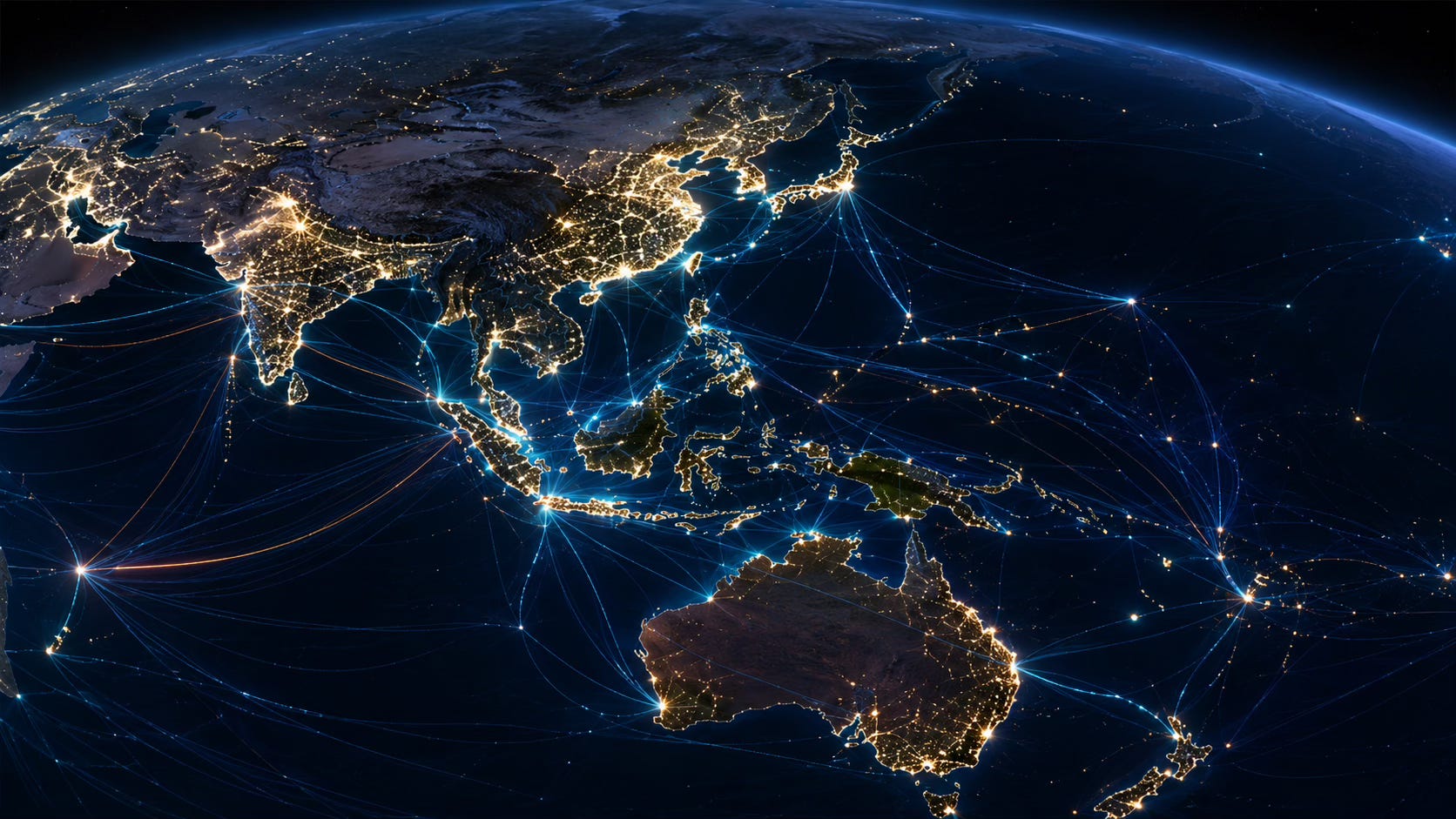
In today’s integrated global economy, the countries that might form the core of a new institution share far more than they did when SEATO was created. China, poor and largely isolated from the rest of the world in 1954, is now the world’s largest goods-trading nation and the principal military competitor to the United States in the region. 12
North Asia became a global center of manufacturing, technology and capital. Now South Asia is gaining economic momentum. India is the world’s most populous country, while the region’s strategic ports and position along the sea lanes connecting Asia with the Middle East, Africa, and Europe have given it growing geopolitical importance. In fact, North and South Asia have increasingly become part of the same economic and strategic super system, with South Asia emerging as its demographic growth engine.13
Security and economics can no longer be conceptually separated, if they ever could be in practical terms. The same countries that depend upon one another for intelligence and military cooperation increasingly depend upon one another for critical minerals, semiconductors, pharmaceuticals, energy, technology and industrial capacity. They are irreducibly linked by shipping lanes, fiber-optic cables and the enormous data centers that underpin the digital economy. China has shown its willingness to disrupt supply chains. War, weather and disease can disrupt them overnight.14
This is the fundamental difference between 1954 and today. What SEATO lacked then may finally exist: a deeply interconnected economic system whose members have common security interests worth defending collectively.
This Isn’t Only About China
China makes the institutional gap more urgent to remedy, but it is not the only reason to close it. Other threats, from COVID to earthquakes, can require an immediate joint response.
There is also a broader global trend. The search for stronger institutions is not confined to Asia. On August 7, Saudi Arabia, Turkey and Pakistan signed the Mecca Joint Defense Agreement. Rachel Bronson, writing for the Chicago Council on Global Affairs, describes it as a “NATO-style agreement”: an attack on one signatory is to be treated as an attack on all. She sees countries formalizing their own security and economic agreements rather than waiting for Washington to design them, and contrasts this binding agreement with another, looser network linking the UAE, Israel, Greece and India.15
❝The mass-and-depth coalition is building the harder, more binding commitment; the network-and-agility coalition, for now, has not. Whether that reflects strength (a signal that agile states don’t need formal treaties to move together) or exposure will become clear only as the rivalry unfolds.
—Rachel Bronson, The Chicago Council on Global Affairs
This is precisely the tension confronting the Indo-Pacific: how to preserve the agility of its existing networks while gaining the clarity, permanence and economies of scale that stronger institutions can provide. Can the region continue to rely on an increasingly elaborate network of understandings, or does it need to begin translating some of those understandings into clearer mutual obligations?
China could not realistically belong to such a collective-defense institution. Mutual defense requires strategic trust among its members. But that does not mean the institution’s purpose should be reduced to containing China. China may be one of the factors making IPACT necessary, but China should not define its purpose. It would remain engaged through interlocking institutions such as APEC, PECC, and CSCAP.16 Those channels of economic and diplomatic engagement would continue, alongside closer cooperation among IPACT partners.
Australia the Institution Builder
Australia has been an active participant in the Indo-Pacific project. A strong US ally, it nonetheless has indispensable trade relationships with China. Australia has much to lose if things fall apart.
Sir Percy Spender’s role in creating ANZUS began a long Australian tradition of regional institution-building. Four decades later, in 1989, Prime Minister Bob Hawke proposed what became APEC because Asia-Pacific economic integration was advancing faster than the institutional framework to manage it. Australia hosted APEC’s first ministerial meeting in Canberra in November 1989, chaired by Foreign Minister Gareth Evans. Prime Minister Paul Keating strongly advocated elevating APEC to the leaders’ level, and President Bill Clinton convened the first APEC Economic Leaders’ Meeting in 1993.17
When the United States withdrew from the Trans-Pacific Partnership (TPP) in January 2017, Australia and Japan helped preserve it as the CPTPP. 18 Today, Australia is building AUKUS with the United States and the United Kingdom to strengthen security.
When regional realities have outrun existing institutions, Australia has not only adapted to the new order, it has helped design the next one. Perhaps this is another such moment, when Australia could play a similar role. What might this new institution look like?
A Proposal: IPACT
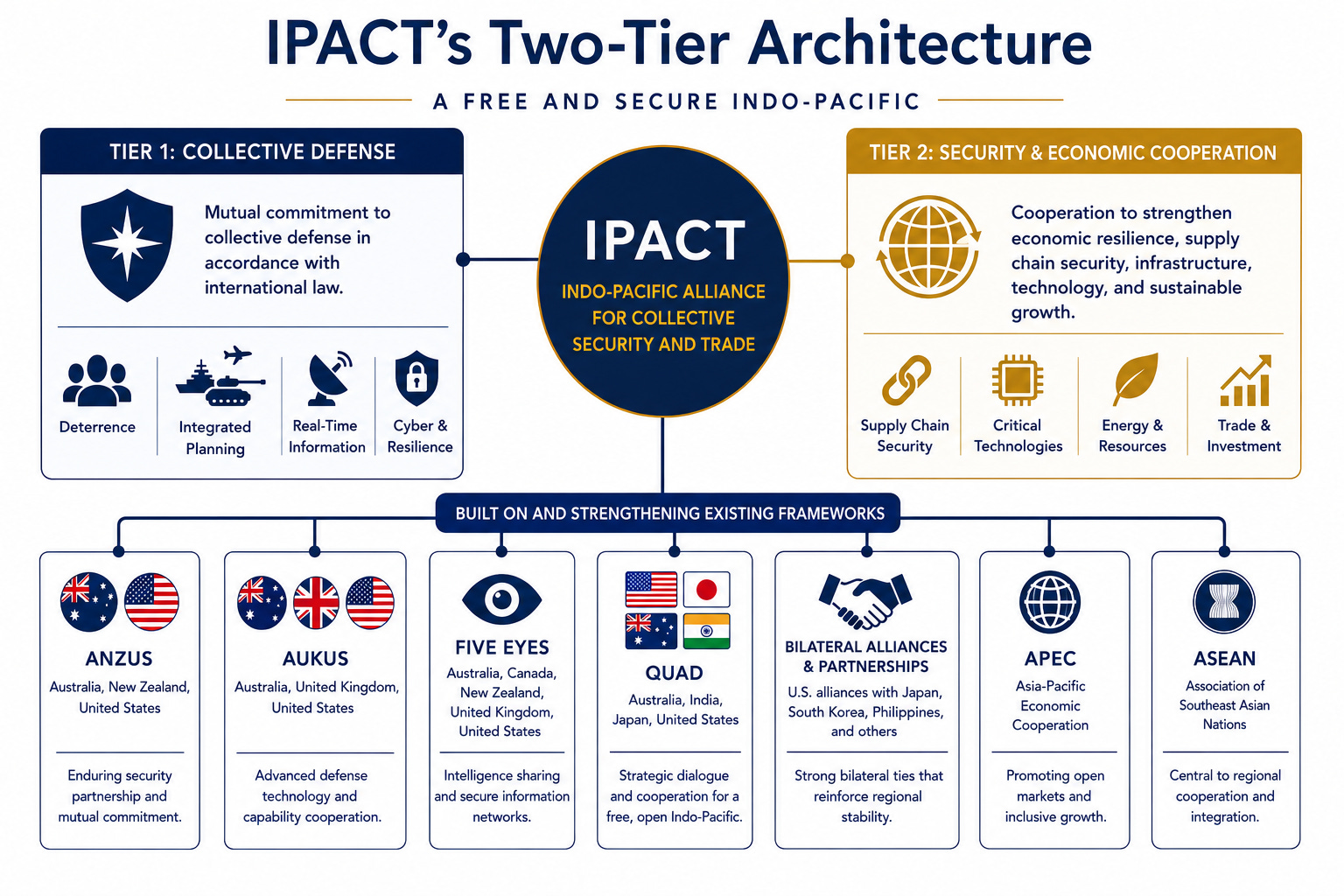
IPACT would be built around two principles that can no longer be separated: collective defense and collective economic resilience. IPACT would not replace institutions that already exist such as ANZUS, AUKUS, Five Eyes, the Quad and the bilateral alliances that each perform different functions. It would provide what they collectively lack, an institutional roof over the existing security grid.
This is where IPACT differs from Campbell and Doshi’s conception of “allied scale.” They propose a system “powered by the White House, built around concrete projects, and organized through ad hoc coalitions of willing allies.” Their approach preserves the agility that has been one of the strengths of Indo-Pacific cooperation, but also its dependence on Washington. IPACT would attempt to preserve that flexibility while giving it greater institutional permanence—particularly important when, as Campbell and Doshi themselves argue, allied commitments must be able to outlast any single president.19
Stewart Patrick makes the case for preserving flexibility from another direction. He supports flexible minilateral arrangements that allow countries to cooperate in a “modular, nimble, and selective manner” while warning that they can exacerbate fragmentation and cannot entirely substitute for standing institutions.20 This is the same tension Rachel Bronson identifies between agility and exposure. IPACT would attempt to reconcile the two rather than choose between them.
Nor should IPACT repeat SEATO’s mistake of assuming that every participant can make the same commitment. A two-tier architecture could position at its core countries prepared to make credible reciprocal defense commitments: an Article 5-type obligation intended to remove doubt about what happens when one member is attacked.
Countries that choose the second tier could participate deeply in economic resilience, technology, maritime security, logistics and supply-chain cooperation without assuming the same collective-defense obligation. India is the obvious example. It is too important to the Indo-Pacific economic and security system to exclude, but it is unlikely to abandon its tradition of strategic autonomy. Other countries might make the same choice. Nor would IPACT replace ASEAN, for example, or preempt agreements such as the Australia-India February 2026 security treaty.
The objective would not be to add another layer of bureaucracy or simply to spend more, but to get more from resources already being spent: common planning, greater interoperability, coordinated procurement and logistics, strategic reserves, complementary industrial capacity and more resilient allied supply chains. IPACT would need to convert “allied scale” into allied efficiency.
Gareth Evans is right to ask whether America would sacrifice San Francisco for Sydney.21 Hugh White has raised the same underlying concern, arguing that Australia must prepare for a world in which American leadership in Asia can no longer be taken for granted.22 This raises another question: should Australia and other regional democracies take the initiative in their own backyard and build an overarching defense and trade institution with the United States, rather than waiting for Washington to build one for them?
The TPP experience demonstrates why Australians should never assume American commitments are immutable. But that is precisely an argument for the establishment of durable institutions in the Indo-Pacific. Governments change; institutions can make more lasting commitments.
Conclusion
In 1954, supply chains existed to support alliances. Today, alliances increasingly exist to protect supply chains.
The Indo-Pacific already has extensive economic integration and military capability. What it lacks is an institution capable of connecting the two. Australia, as a democratic middle power with a long history of institution-building, could once again play a leading role.
The first SEATO was built to defend nations. IPACT could help defend both the countries of the Indo-Pacific and the networks that connect them.
Lyric Hughes Hale
Joined econVue: JANUARY 1, 2012

Lyric Hughes Hale serves as Editor-in-Chief of econVue, and hosts The Hale Report, a podcast series on global economics. Hale is founder and chair of the Hale Strategic Resources Initiative, and is a member of the board of the Australian American Leadership Dialogue.
📍Chicago
Upcoming

On Tuesday, September 1, Lyric Hughes Hale will host a live discussion for econVue+ subscribers on Indo-Pacific economic and security issues—and the IPACT proposal. Join me→
Become an econVue+ subscriber to receive notifications of new posts, podcasts, and live events.
Footnotes
Defence Legislation Amendment (Naval Nuclear Propulsion) Bill 2023 Parliamentary Library, Parliament of Australia, 2023. The Parliamentary Library reports an estimated A$268–368 billion cost over 30 years for the nuclear-powered submarine component of the broader AUKUS program.
Trends in World Military Expenditure, 2025, Stockholm International Peace Research Institute (SIPRI), April 2026. SIPRI estimates 2025 military expenditure at US$954 billion for the United States, US$336 billion for China, US$62.2 billion for Japan and US$47.8 billion for South Korea; its database supplies the Australian figure used in the combined total.
Secretariat Account: 2025 Proposed Budget and Members’ Contributions, Asia-Pacific Economic Cooperation, 2024. The approved 2025 Secretariat Account budget totals S$9,591,100.
Consolidated Financial Statements for the Year Ended 31 December 2024, Pacific Islands Forum Secretariat, 2025. The consolidated statements cover the Secretariat and Pacific Trade Invest offices in Australia, China and New Zealand.
How Alliances Survive: The Case Against Pessimism and the Path to a New Allied Order, Kurt M. Campbell and Rush Doshi, Foreign Affairs, September/October 2026. The essay develops their concept of “allied scale.”
Notes on Talk Concerning a Pacific Pact, Australian Department of External Affairs, October 13, 1950. Spender told US officials that he wanted a Pacific pact modeled particularly on Article 5 of the North Atlantic Treaty. Contemporary Australian diplomatic records also document his sustained campaign for a broader Pacific security arrangement.
Security Treaty Between Australia, New Zealand and the United States of America, signed September 1, 1951. Article III provides for consultation; Article IV states that each party would act to meet a common danger “in accordance with its constitutional processes.”
Southeast Asia Treaty Organization (SEATO), 1954, Office of the Historian, US Department of State. SEATO maintained no military forces of its own and lacked NATO’s independent mechanisms for intelligence and deployment.
Progress Report Prepared by the SEATO Military Advisers for the SEATO Council, Foreign Relations of the United States, 1958–1960, Volume XVI, April 7, 1959. The report documents the work of SEATO’s Military Planning Office and a series of combined air, naval and ground exercises. See also Memorandum on SEATO Military Planning — Foreign Relations of the United States, 1958–1960, Volume XVI, March 1959, which concluded that “No SEATO Command organization in being is required at this time” and contemplated creation of a combined command only when a SEATO plan was activated.
Funding NATO, NATO, updated April 8, 2026. SEATO organizational budget, fiscal year 1959–60 Congressional Record, 1959; SEATO’s approved organizational budget was $896,860.
Southeast Asia Treaty Organization (SEATO), 1954, Office of the Historian, US Department of State. Pakistan formally withdrew in 1973; France was also pulling away; following the end of the Vietnam War in 1975, SEATO was wound down and formally disbanded in 1977.
Global Trade Outlook and Statistics, World Trade Organization, March 2026. China exported US$3.77 trillion in merchandise in 2025 and accounted for about 14.4 percent of world merchandise exports over the preceding three years.
South Asia Economic Update: Working with Industrial Policy, World Bank, April 2026; World Population Prospects 2024, United Nations Department of Economic and Social Affairs. South Asia grew 7 percent in 2025 and remains the fastest-growing emerging-market and developing-economy region, principally because of India. India is the world’s most populous country, with Pakistan and Bangladesh also among the world’s largest and growing populations.
WTO Trade Policy Review of China: Australia Statement, Australian Department of Foreign Affairs and Trade, 2021. Australia stated that Chinese measures had severely limited or ended trade across more than a dozen commodities and cited credible reports that Chinese authorities had instructed importers not to purchase certain Australian products.
The Gulf’s New NATO?, Rachel Bronson, Chicago Council on Global Affairs, August 12, 2026. Bronson examines the August 7 Mecca Joint Defense Agreement among Saudi Arabia, Turkey and Pakistan and contrasts its binding mutual-defense commitment with a looser UAE-Israel-Greece-India network.
APEC Member Economies; PECC Member Committees; CSCAP Member Committees. China joined APEC in 1991, its PECC committee dates to 1986, and it participates in CSCAP through the China Institute of International Studies.
About APEC, Asia-Pacific Economic Cooperation. Bob Hawke publicly proposed the idea in January 1989, the first ministerial meeting was held in Canberra that November, and Bill Clinton established the annual APEC Economic Leaders’ Meeting in 1993.
Japan and Australia: Leading Asia Pacific Regionalism in Uncertain Times, Australian Department of Foreign Affairs and Trade, 2018; see also Proposed Comprehensive and Progressive Agreement for Trans-Pacific Partnership Parliament of Australia. Following the US withdrawal from the TPP on January 23, 2017, Australia and Japan played leading roles in preserving the agreement among the remaining eleven countries.
How Alliances Survive: The Case Against Pessimism and the Path to a New Allied Order, Kurt M. Campbell and Rush Doshi, Foreign Affairs, September/October 2026. Campbell and Doshi advocate concrete projects and flexible coalitions while also arguing for commitments durable enough to survive changes of administration.
The Middle Power Moment, Stewart Patrick, Carnegie Endowment for International Peace, January 20, 2026. Patrick argues that middle-power cooperation is likely to involve shifting minilateral coalitions, with subsets of countries opting into or out of particular initiatives. He describes the advantages of arrangements that permit states to cooperate in a “modular, nimble, and selective manner,” while cautioning that minilateralism can exacerbate global fragmentation and cannot entirely substitute for standing institutions.
The Case Against AUKUS, Gareth Evans, The Saturday Paper, July 25, 2026. Evans argues that ANZUS has never legally guaranteed US defense of Australia and dismisses the assumption that the United States would be prepared to “sacrifice San Francisco for Sydney.”
Albanese’s Folly of Pandering to Donald Trump — Hugh White, The Saturday Paper, October 25, 2025. White argues that Australia can no longer assume continued American strategic leadership in Asia and should focus more attention on the regional countries and leaders capable of shaping its future.