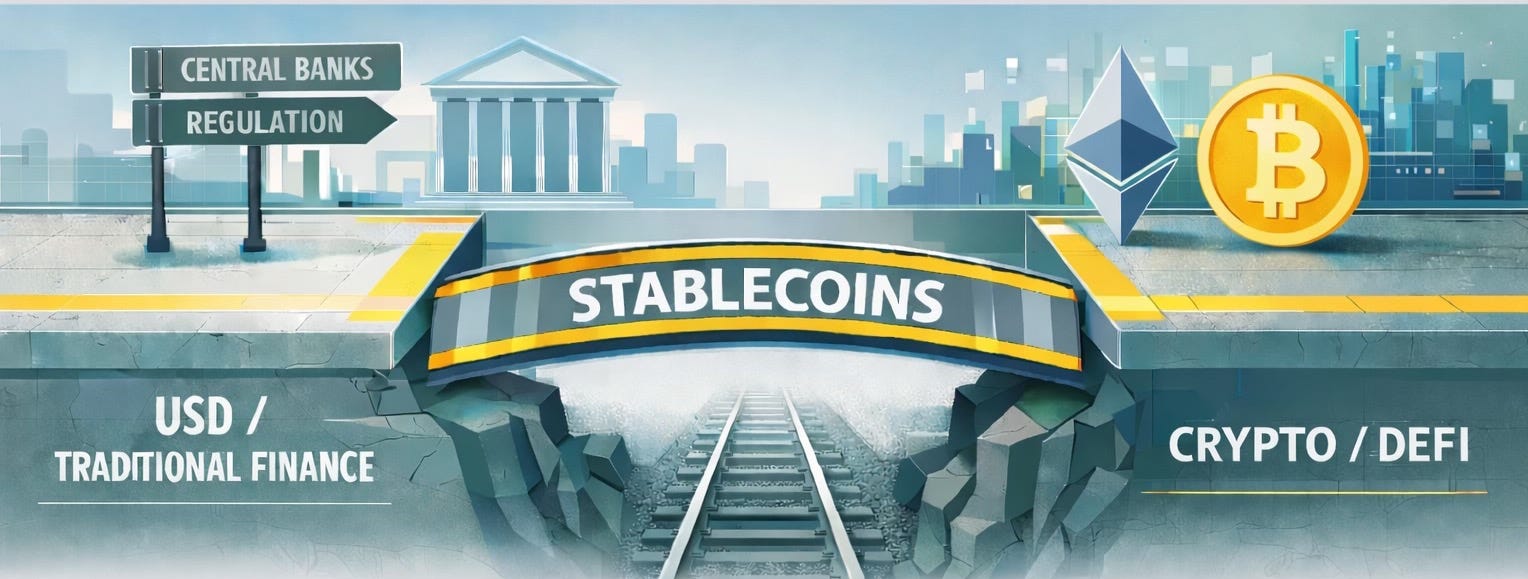
Mind the Regulatory Gap in Stablecoins
Part II : Tokenization and the Future of Money
Editor’s Note: Stablecoin companies have become major holders of US Treasuries. Does this create systemic risk? Economist Karim Pakravan explores how traditional and non-traditional financial systems interconnect through stablecoins, but is signaling us to “mind the gap” between the two. This article is Part II of a two-part series. Subscribe for more on this topic and to receive a link to the replay of our econVue panel on stablecoins on January 7.
The Regulatory Challenge
I. Regulating Tokenized Monies (Stablecoins)
As stablecoins move from being niche assets used to speculate in the crypto market to the mainstream of payments and settlement, the issue of regulation has taken renewed urgency. Currently, tokenized monies (stablecoins) are in a regulatory limbo. In effect, stablecoin issuers are enjoying the benefits of being deposit-taking institutions without bearing the corresponding responsibilities.
As pointed out earlier in this series, tokenization per se does not alter the fundamental features of money and assets, but it displaces traditional intermediaries in favor of peer-to-peer transactions, using distributed ledgers for settlement. As such, it poses unique macro-financial risks to the financial system. Furthermore, the cross-border nature of stablecoins introduces additional layers of regulatory complexity. Moreover, as more traditional financial intermediaries (banks, money market funds, payment systems, etc.) enter the stablecoin domain, the result is a hybrid and interconnected system with no clear or coherent regulatory framework.
Why should we regulate stablecoins? A recent study by the International Monetary Fund (IMF), Understanding Stablecoins, provides a useful framework. The IMF study identified four categories of risk:
Macro-financial stability
Financial integrity
Operational efficiency
Legal certainty

Macro-financial Stability
Reserves held by stablecoin issuers are subject to market, credit, and liquidity risk. Therefore, stablecoins lack the “singleness” of money, meaning that different stablecoins are not necessarily redeemable at par with one another or with sovereign money. The United States faced a similar problem prior to the National Banking Acts of 1863-64, when thousands of local banks issued their own banknotes with uneven backing and frequent losses for holders. According to the Federal Reserve:
❝ Before the Civil War, the United States lacked a uniform national currency. Thousands of state-chartered banks issued their own banknotes, which varied in reliability and value depending on the financial condition of the issuing bank.
—Federal Reserve History, The National Banking Acts of 1863 and 1864
As in the pre-1863 system, concerns about reserve quality and liquidity make the stablecoin ecosystem vulnerable to runs, which could spread rapidly across issuers and into connected traditional banks. In the traditional financial system, institutions benefit from explicit public backstops (central banks and deposit insurance) which provide liquidity and solvency support in the event of systemic shocks. This safety net was activated during the 2008 financial crisis, helping to avert a financial meltdown and economic collapse.
By their nature, there is an inherent conflict between the commitment to full convertibility and the profitability of stablecoin issuers. Maintaining liquid, high-quality reserves is costly, while returns depend on investing those reserves.
Stablecoin issuers can also affect the broader financial system through their holdings of government securities. The largest issuers, such as Tether and Circle, now hold hundreds of billions of dollars in US Treasuries. If stablecoins grow to a projected $2-3 trillion market, their Treasury holdings will expand accordingly, making them major players in sovereign debt markets. On the one hand, this provides an additional source of funding for fiscal deficits. On the other, large-scale liquidation of these holdings to meet redemption demands could amplify yield volatility and systemic risk.
Unlike traditional financial institutions, stablecoin issuers do not have formal access to lender-of-last-resort facilities.Yet the implicit expectation within the crypto ecosystem may resemble the “too-big-to-fail” logic of 2008, potentially forcing monetary authorities to intervene during a crisis to prevent broader contagion.
This situation calls for a macroprudential regulatory framework analogous to that applied to banks, including liquidity requirements, capital standards, asset-quality rules, disclosure, and auditing. To strengthen systemic resilience, stablecoin issuers should be required to hold reserves at the central bank. In return, they would gain access to official financial backstops—accepting regulation in exchange for stability.
Clarifying the Non-Lending Argument
Stablecoin issuers often argue that, unlike banks, they do not extend loans and therefore should not be subject to bank-style capital requirements. While it is true that stablecoins do not engage in traditional credit intermediation, this does not eliminate the need for prudential safeguards. Stablecoin issuers still promise par redemption on demand, engage in liquidity transformation, and concentrate market and operational risks—particularly through large holdings of sovereign securities. Capital and liquidity requirements are not solely designed to absorb credit losses, but also to mitigate run risk, operational failures, and forced asset sales that can destabilize the broader financial system. The appropriate framework may differ from that of commercial banks, but the absence of lending activity does not justify the absence of regulation.
Financial Integrity
Cryptocurrencies emerged as a system that can bypass the legacy monetary system based on sovereign-issued fiat money. They reflect, in part, a lack of confidence in the legacy system. At the same time, tokenized currencies face significant operating risks: fraud, money laundering, illegal capital movements, illegal activities, hacking and redemption risk, among others.
Offshore dollar-linked stablecoin issuers amplify these risks and complicate enforcement. Pseudonymity, unhosted wallets, low transaction costs, and frictionless cross-border transfers create an ideal environment for financial crime, including money laundering, terrorist financing, corruption, weapons purchases, and drug trafficking. Stablecoins also combine these features with relative price stability and growing adoption, although the durability of this stability remains untested under stress.
Anti-Money Laundering (AML) standards established by the Financial Action Task Force (FATF) rely on Know-Your-Customer (KYC) rules and transaction monitoring. These principles must be extended and effectively enforced within the stablecoin ecosystem.
The Financial Action Task Force (FATF, https://www.fatf-gafi.org/) is a global intergovernmental institution leading global action to tackle money laundering, terrorist and proliferation financing.Operational Efficiency
All financial systems face operational risks, but stablecoins introduce additional—and in some cases still unknown—vulnerabilities. Distributed ledger systems are susceptible to cyberattacks and hacking. Fragmentation across multiple blockchains complicates interoperability, communication, and settlement. Moreover, users often have limited understanding of these risks and minimal legal recourse in the event of failure.
Many operational risks will only become visible as the system scales. Regulators must therefore require issuers to implement robust risk-identification, mitigation, and resilience frameworks.
Legal Certainty
There is no clear legal classification of stablecoins. Are they bank deposits, or intangible assets? What is the standing of stablecoin owners in the event of custodian insolvency? What about the problem of multiple jurisdictions?
Bottom Line
We should not wait for a cryptocurrency-induced financial crisis to introduce prudential regulations on stablecoins. Stablecoin issuers should not rely on the implicit “too-dangerous-to fail” assurance of an official bailout in the event of such a crisis. They cannot enjoy the benefits of being banks without the responsibilities that they should meet.
The 19th-century US “Wild West” banking era was tamed by the Banking Act of 1863, which effectively limited note issuance to federally supervised national banks. The same principle should apply to stablecoins today.
There are a number of steps that should be taken to mitigate the risks attached to stablecoins:
Integrate stablecoin issuers into the legacy financial system, subject to the same macro-prudential rules and AML regulations.
Require stablecoin issuers to hold reserves at central banks in exchange for access to official backstops
Mandate deposit insurance
Allow the Federal Reserve to issue its own digital currency (currently prohibited by the GENIUS Act)
Promote international regulatory cooperation
II. Current Regulatory Framework
The European Union, Japan and the UK are ahead of the US in terms of crypto/stablecoins regulation. In the United States, the infrastructure is still under construction.
The Trump administration has advanced two major legislative initiatives. The GENIUS Act (Guiding and Establishing National Innovation for US Stablecoins) enacted last July, provides the high-level regulatory framework, while the CLARITY Act (Crypto-asset Legislative and Regulatory Transparency Initiative Act), still awaiting a Senate vote, is intended to supply operational detail.
The legislation aims to regulate tokenized stablecoins pegged to sovereign currencies, typically the US dollar. In addition, other rules regulating digital asset market structure and banning central bank digital currencies were also passed by the House of Representatives, but still need to be voted on by the Senate.
The GENIUS ACT
The GENIUS Act defines a stablecoin as a digital asset issued for payments and settlements redeemed at a predetermined fixed rate to a sovereign currency. It requires at least $1 in reserves per stablecoin, broadly defined to include cash, currencies, deposits held in commercial banks, short-term Treasury bills, repos, money market funds, and central bank reserves.
However, capital requirements, liquidity standards, and risk management rules remain undefined. Crucially, stablecoin issuers are exempt from bank-level capital standards, and deposits are not insured.
Issuance is open to approved non-bank financial institutions through a newly proposed Stablecoin Certification Review Committee. Non-financial firms are excluded, while foreign issuers may operate through “reciprocal arrangements” with other jurisdictions.
Overall, the GENIUS Act reflects strong fintech lobbying pressure to minimize regulation. The crypto-friendly Trump administration, staffed with a number of self-interested crypto advocates, has shown receptiveness to these views. Recent executive actions, including efforts to open pension funds to digital assets, suggest further regulatory relaxation. Similar pressures are visible abroad, with institutions such as the Bank of England retreating from tougher standards.
The CLARITY Act
The GENIUS Act is supposed to be complemented by the CLARITY Act, which has been approved by the House, but not the Senate. The Clarity Act defines digital commodities and provides the framework for their regulation. The main regulator is the Commodities Futures Exchange Commission (CFTC), which is to establish rules for trading, monitoring, record keeping, disclosure, and commingling of customer assets. Brokers and traders in the digital commodities ecosystem will be regulated by the Securities and Exchange Commission (SEC).
III. The Political Economy of Regulation
Implementing a reasonable and effective regulatory framework in the United States faces a powerful crypto lobby aligned with the Trump administration’s preference for de minimis oversight. The tech industry’s unprecedented political influence has allowed regulatory capture, allowing it to shape both policy design and enforcement priorities. While opposition to central bank digital currencies (CBDCs) is often grounded in legitimate concerns, including privacy, civil liberties, and the risk of disintermediating the banking system, the GENIUS Act’s categorical ban on a CBDC reflects a broader political environment in which industry preferences have exerted disproportionate influence over the regulatory debate.
The primary regulators, the CFTC and SEC, came under new leadership in 2025. According to a recent analysis by the New York Times the SEC significantly reduced or paused enforcement in a large share of inherited cryptocurrency cases after early 2025. Some of these cases involved firms with financial or business ties to President Trump or his family’s crypto ventures, though the report did not find evidence of presidential interference or pressure on the agency decisions.
Given this policy bouleversement, it is not surprising that both supporters and opponents of stablecoins are ready to pour millions into the 2026 midterm elections.
IV. Conclusion
Stablecoins represent a major monetary innovation, and may be at the center of the next generation of tokenized central bank reserves, tokenized central bank money, and tokenized bonds. They represent major advantages in terms of speed, efficiency, and cost. But credibility requires integration into the regulated banking system.
The future monetary architecture should combine crypto and legacy finance within a unified regulatory framework, anchored by tokenized central-bank money and sovereign assets. The political battle has only begun—and history suggests it would be far better to regulate now than to wait for crisis to force action. However, in order to become respectable, stablecoin issuers need to become integrated in the legacy banking system and follow the same rules. In effect, they need to become like banks.
Stablecoins are no longer a peripheral experiment at the edge of finance. As their issuers accumulate sovereign debt, interface with traditional banks, and embed themselves in payment and settlement systems, they increasingly resemble the institutions they once sought to bypass. Karim Pakravan’s analysis makes clear that the challenge now is to mind the gap between two systems that stablecoins are actively connecting. The question is no longer whether stablecoins will matter, but whether policymakers will impose the regulatory discipline needed to prevent a replay of earlier monetary failures. The choice is not between innovation and regulation, but between foresight and crisis.
Karim Pakravan
Karim Pakravan is an academic, global finance specialist, and consultant in the fields of emerging markets, international finance, monetary policy, and banking regulation.
📍Chicago
You can also follow Karim on Random Access Economics: