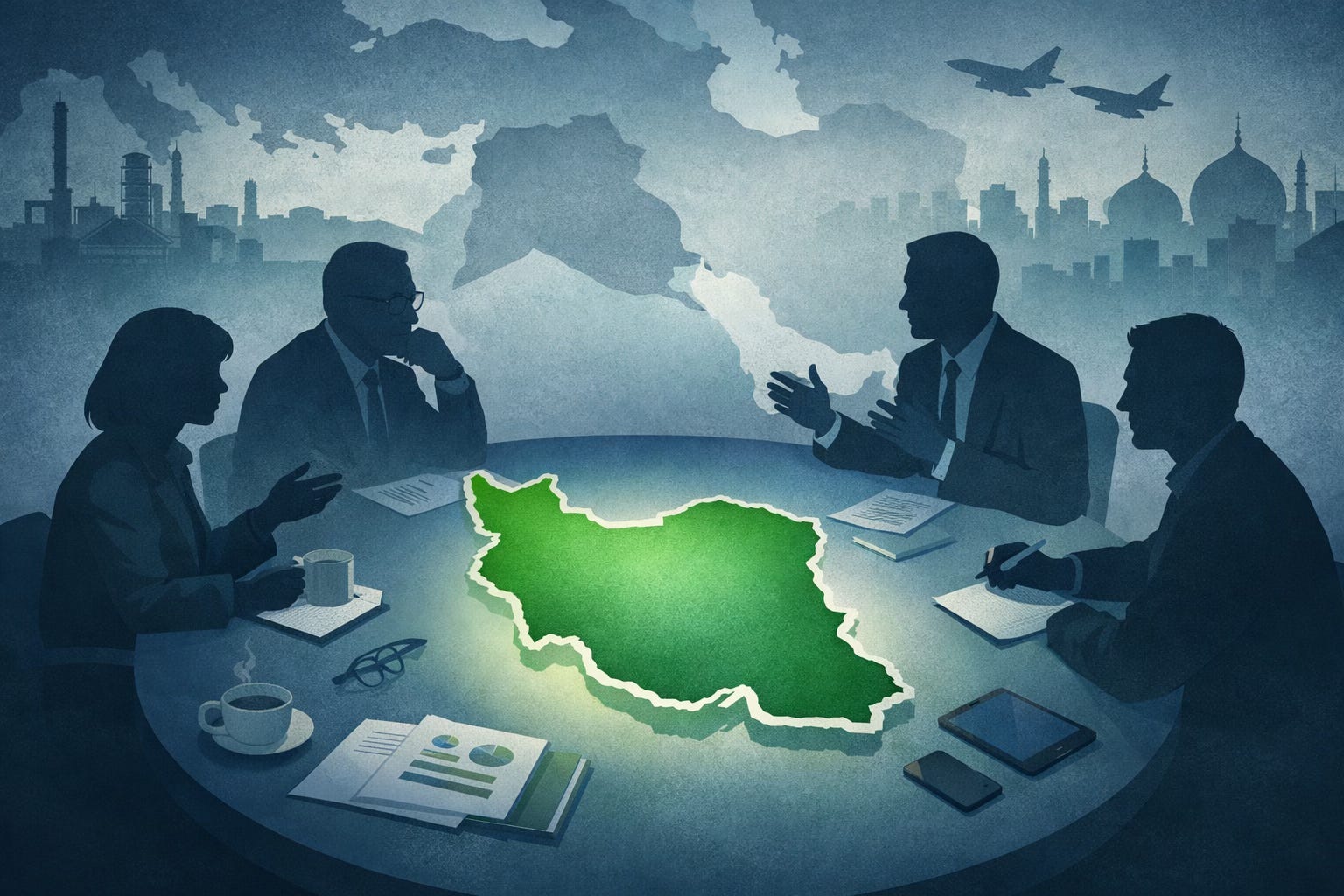
REPLAY: econVue Panel 👥 Iran Update
Iran's Impossible Trade-offs (Jan 19, 2026) with Karim Pakravan
🗓 Mon, Jan 19 at 10 am CST
Iran Update: econVue Panel Discussion (Replay)
As war looms and events unfold in the Middle East, econVue convened a Chicago-based group of economists, commentators, and social scientists for an analysis of Iran—grounded in political economy, sanctions constraints, and regional security dynamics.
Watch the replay
Date: Monday, January 19, 2026 — 10:00 AM CST - 56 minutes
Host: Lyric Hughes Hale
Guest Moderator: Karim Pakravan
Note on format: This replay includes panelists’ prepared remarks only.
Opening remarks: Lyric Hughes Hale
On Martin Luther King Jr. Day, Lyric Hughes Hale opened the discussion by borrowing Dr. King’s most famous words—“I have a dream”—to express a personal hope: to return someday to Iran, where she lived as a child. She framed the conversation as an econVue discussion grounded in risk, economics, and real-world constraints, and introduced Karim Pakravan as moderator—an economist and former country-risk professional uniquely positioned to navigate Iran’s “impossible tradeoffs.”
What you’ll hear in this replay
In their prepared remarks, panelists focus on a core question posed by moderator Karim Pakravan:
Not what Iran should do, but what options are realistically available—to Tehran, Washington, regional actors, and Iranian society—given sanctions architecture, energy markets, and security dynamics.
Topics include:
How piety and patronage combine in Iran, making change difficult
Why “black-and-white” framings of Iran routinely fail
How sanctions reshape class structure, incentives, and internal power coalitions
The political economy of elite wealth and regime durability
Competing pathways: sudden collapse vs negotiated transition vs internal reshuffling
Spillover risks for neighbors—and the region’s economic chokepoints
Key takeaways (Panelists’ remarks)
“This time it’s different” — but not necessarily in the way outside observers assume. Panelists argue Iran cannot be analyzed as a fragile “banana republic” whose leadership can be “decapitated” into immediate collapse.
Political economy matters as much as ideology. A recurring theme is the role of elite incentives, the emergence of new wealth tied to state/security networks, and the constraints this creates for reform or transition.
Iran is not monolithic. Several panelists emphasize internal fragmentation, the regime’s dual structure, and recurring cycles of protest and repression—alongside moments of limited reform.
External pressure shapes internal dynamics. Sanctions and isolation are treated not as background conditions but as active forces that reshape the regime’s paranoia, survival strategies, and the space for pluralism.
Any transition requires an “offer.” The discussion repeatedly returns to what a real “exit ramp” would look like—an offer to elites, security forces, and the governing structure that can actually be implemented.
The economy is the system constraint. Across scenarios—status quo, internal change, or broader transition—panelists agree economic deterioration is a decisive pressure point.
Selected pull quotes: Will meaningful regime change take place?
“What we know for sure is this time it’s different.” — Karim Pakravan
“The question before us is not what Iran should do, but what options are realistically available…” — Karim Pakravan
“Discount the rapid collapse scenario and figure out how the negotiated exit is going to be formed.” — Narimon Safavi
“Replaced with what?” — Kaveh Ehsani
“It’s the economy—stupid'… the Achilles’ heel of the regime…” — Kaveh Mirani
↳ Panelists
Guest Moderator: Karim Pakravan
Economist with training at the University of Geneva and the London School of Economics, and a PhD from the University of Chicago. Pakravan brings a rare blend of academic economics and real-world finance, including experience in country risk, which shaped the panel’s emphasis on constraints, incentives, and scenario realism.
📍Chicago
Narimon Safavi
Iranian-American entrepreneur, commentator, and cultural advocate based in Chicago; co-founder of Pasfarda Art & Cultural Exchange. Safavi’s work spans media appearances (including NPR, PBS, BBC) and public speaking on Iran and cultural policy. In this panel, he emphasizes political economy, elite incentives, and why negotiated transition may be more plausible than rapid collapse.
📍Chicago
Kaveh Ehsani
Associate Professor of International Relations at DePaul University and an expert on the political economy and geopolitics of post-revolution Iran. His work also addresses the historical and contemporary impact of oil, urban processes, and spatial change in Middle East cities. He has served as a consultant to institutions including the UNDP and the World Bank. Ehsani situates Iran’s current moment in longer cycles of reform, protest, repression, and external pressure.
📍Chicago
Kaveh Mirani
Chicago-based entrepreneur and close observer of events in Iran, which he visits regularly. He attended the University of Tehran and holds a PhD in Economics from the University of Chicago. Mirani offers a scenario framework for possible outcomes and argues that—regardless of political pathway—the economic constraint will force reform or intensify instability.
📍Chicago
About econVue
econVue convenes experts across economics, finance, geopolitics, and technology to provide broad context—and to resist simplistic narratives—especially in moments of rapid change. Our goal is to bring expert voices, a global focus, and an informed perspective to the issues that shape markets and societies.
During panel discussions, introductory remarks by our speakers will be recorded, but the Q&A session are off the record. Become a subscriber for the full experience!⧉ Background
Recommended reading will be shared with all registered attendees in advance of this panelTwo recent reports by our panelists:
By Narimon Safavi:
By Karim Pakravan:
Editor-in-Chief
📍Chicago
–𝓁𝓎𝓇𝒾𝒸
Lyric Hughes Hale
Editor-in-Chief