

The Case for a Consolidated Indo-Pacific Alliance–Do We Need a 21st Century SEATO?
Part I: The Power of Collective Action

In 1954, when SEATO was first established, supply chains existed to support alliances. Today, alliances increasingly exist to protect supply chains.
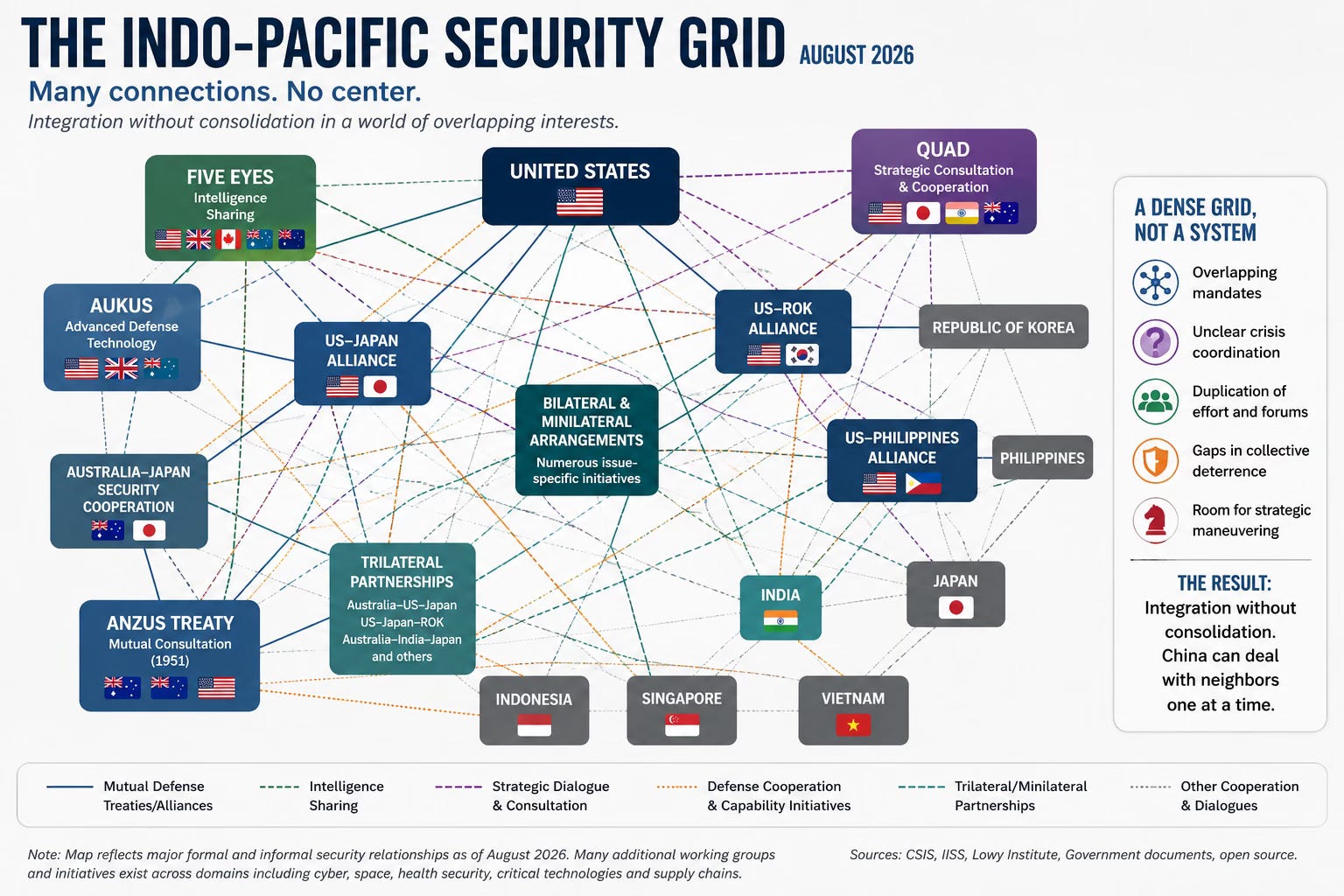
Institutions of all kinds are under threat. AI is challenging our assumptions about the value of higher education, and decentralized finance and cryptocurrencies are calling into question the absolute authority of central banks. But this does not mean that all institutions should be discarded. In this world of geopolitical conflict, strong institutions make an enormous difference, and the defense sector is gaining momentum and fiscal support. This is despite the US position that global security burdens should be more widely shared, especially within NATO.
But since NATO was formed in 1949, the world’s economic center of gravity, and increasingly its security interests, have shifted away from Europe toward the Middle East and the Indo-Pacific. As China in particular has grown more expansionary throughout the region, while doubling down on its claims over Taiwan, it is clear that the response of the US and its allies has been, at best, fragmentary. There are a multitude of overlapping working groups, alliances, and institutions in the region, but none rival the power and cohesion of NATO.
At one time, however, there was an effort to create a parallel institution in Asia called SEATO, founded in 1954. Perhaps that effort was premature, but we might have waited too long to revive it. Now there is ANZUS, AUKUS, the Quad, Five Eyes, APEC, US alliances with Japan, South Korea and the Philippines, Australia-Japan security cooperation, and a growing collection of trilateral arrangements. Intelligence is handled by one group, advanced defense technology by another, mutual-defense obligations by bilateral treaties and strategic consultation by still others. The result is integration without consolidation. The problem is not too little cooperation, but too much fragmented cooperation in a world where economic and defense objectives increasingly overlap.
The Power of Collective Action
There is another consequence of fragmentation: it allows the region’s largest, undemocratic power to deal with its neighbors one at a time. Middle powers may believe they can protect their autonomy by balancing between the two superpowers, preserving access to Chinese markets while relying on the United States for security. But there are limits to how long that strategy can succeed.
Game theory tells us how this works. China, negotiating with Australia, the Philippines or even Japan individually has enormous leverage. The same countries acting collectively change the calculation. If economic coercion against one produces a coordinated response from the others, the cost of coercion rises and its potential reward falls.
This is the logic of collective action, and equally, deterrence. For middle powers, collective action is not necessarily the surrender of sovereignty, but the means of preserving it. Australia has already experienced this phenomenon directly. When China imposed trade restrictions on a range of Australian exports beginning in 2020, Canberra resisted the political pressure and many producers found alternative markets. The episode demonstrated both the reach of Chinese economic coercion and the ability of a middle power to withstand it.1
The current patchwork of agreements without a clear Article 5-type of obligation for mutual defense creates doubt, confusion, and ambiguity, and gives China ample room for strategic maneuvering throughout the region. From Beijing's perspective, that which is not expressly prohibited by these alliances may appear to be allowed. Where no collective response has been promised, there is room to test where the actual limits lie.
The Illusion of Geography
The US and Australia have historically been the staunchest of allies. Australia has the classic middle power dilemma of our times: how to maintain trade ties with the People’s Republic of China while depending on the United States for its defense. Recently, former Foreign Minister Gareth Evans sought to remind his fellow Australians that the ANZUS alliance “has never legally bound the US to defend us, even in the event of existential attack”:
❝ It is certainly not inconceivable that a major war will erupt between the US and China over Taiwan, even though US President Donald Trump has recently shown much less enthusiasm for rushing to its defence…The big risk here is that Australia will join on the US side, under irresistible pressure from Washington and out of a misplaced-sense of optimism that we will thereby be buying further lifetime insurance protection from our great and powerful ally…
The notion that extended nuclear deterrence justifies our prostration—that the US really would be prepared to sacrifice San Francisco for Sydney, let alone Miami for Melbourne—is and always has been a ludicrous delusion.2
Now to be fair, and not unduly alarmist about US-Australian relations, Mr Evans is not presently in government. But my sense, from talking to and reading the opinions of a wide variety of Australians, is that some of the trust between these two allies, who have fought together in every major conflict since World War I, has eroded.
Nor is that concern entirely without foundation. One example is the Trans-Pacific Partnership (TPP), which the US itself helped negotiate but which both major presidential candidates rejected during the 2016 campaign. The United States subsequently withdrew, while Australia, Japan and the other participants carried on without it. But there is a danger in drawing the wrong conclusion from American unpredictability. China too has acted unilaterally, ignoring the ruling by The Hague in favor of the Philippines in the South China Sea, as one example.
Mr Evans’s assertion that it would not make any sense for Australia to join the US if Taiwan were invaded is startling. He makes this clear:
❝ Our involvement in a war in (Taiwan’s) defense would make almost zero military difference but would come at a vast cost to us, above all economically, with the overnight severance of all links with our major trading partner.3
Evans defines Australia’s interests too narrowly. A conflict over Taiwan would have negative implications far beyond its shoreline, disrupting semiconductor production, sea lanes, telecommunications infrastructure, industrial supply chains and energy, almost everything the country needs to function, and ironically, maintain its economic ties with China.
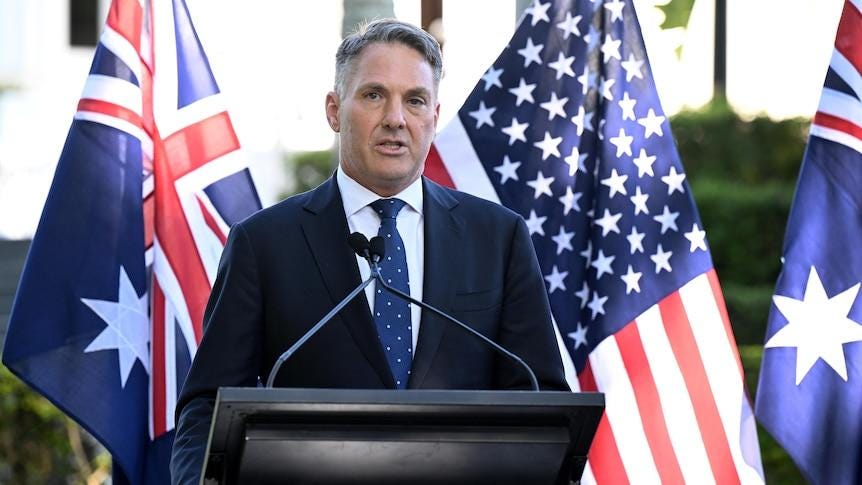
In contrast to Evans, Australia’s Deputy Prime Minister and Defence Minister Richard Marles describes his country’s strategic geography differently:
❝ As an island trading nation our sea lines of communication literally define our national security…the geography of our national security lies well beyond our coastline or even our immediate waters.4
Australia’s national security does not begin at its shoreline because its economy does not end there. Distance once provided Australia with a measure of security, but economic integration has changed the meaning of distance. The country might choose diplomatic neutrality, but its supply chains cannot. They would quickly become tangled up in any conflict between the US and China.
There is a second illusion here as well: that economic dependence and strategic dependence can be compartmentalized. Australia can and should trade with China. But economic engagement is not the same thing as strategic insulation.
Evans also targets AUKUS, saying the agreement with the US and the UK puts a bulls-eye on Canberra’s head. But is the real problem that AUKUS is too small, and too ambiguous? This raises the larger question: would a stable, united front make such a kinetic confrontation less likely in the first place?
Australia’s Current Defense Position
Currently, this nation-continent, the sixth largest country in the world, has only 63,000 active-duty military personnel to protect it. China, the third largest by area, has 2 million, and the US, the fourth largest, has 1.3 million. Another comparison: the US has one active duty service member for every 2.9 square miles, while Australia has one soldier for every 47 square miles, a sixteen-fold difference in military personnel density. Australia also does not possess nuclear weapons, while its planned nuclear-powered submarines are projected to cost hundreds of billions of Australian dollars over several decades.
Sources: Australian Department of Defence; US Department of Defense; Military and Security Developments Involving the People's Republic of China (US Department of Defense); Australian Parliamentary Library.
The critical question is whether Australia and the other middle powers of the Indo-Pacific gain more leverage by preserving their options individually, or by establishing in advance what they will defend collectively. A country of Australia’s scale and population cannot realistically create a defense strategy independent of its economic interests and alliances. But are those alliances and the institutions that support them fit for purpose in an age of increasing geopolitical strife?
Part II: The first SEATO was built to defend nations. IPACT would defend both the nations of the Indo-Pacific and the networks that connect them
Lyric Hughes Hale

Lyric Hughes Hale serves as Editor-in-Chief of econVue, which publishes a best-selling newsletter on Substack. She hosts The Hale Report, a podcast series on global economics. Hale is founder and chair of the
📍Chicago
Footnotes
Chinese Coercion, Australian Resilience — Richard McGregor, Lowy Institute, October 20, 2022. McGregor concludes that China's trade measures beginning in 2020 failed to change Australian national-security policy, while many affected exports were redirected to alternative markets, albeit sometimes at significant cost.
Lowy Institute analysis
The Case Against AUKUS — Gareth Evans, The Saturday Paper, July 25, 2026.
Read Gareth Evans's article
Ibid
Speech to the National Press Club — Richard Marles, Deputy Prime Minister and Minister for Defence, April 16, 2026.
Australian Department of Defence transcript