



The Uncertainty Beneath the Headlines
A week ago, I wrote The Council of Hope, Fear and Jealousy while much of the world’s attention was fixed on the confrontation between the United States and Iran. The headlines have since moved on, as they always do, although the consequences continue to travel quietly across borders.
People living close to the battlefield measure uncertainty through physical danger and survival. Millions of others encounter its consequences in different ways: through higher living costs, volatile energy prices, economic insecurity and difficult decisions made around kitchen tables rather than negotiating tables.
The lingering sense of uncertainty stayed with me as I travelled in recent months through Tokyo, Nairobi, Dubai and New Delhi. Each city possessed its own rhythm, culture and pace, yet the conversations I encountered shared a remarkable familiarity.
I spent more time listening than speaking. Shopkeepers spoke about customers. Entrepreneurs searched for capital. Taxi drivers talked about fuel prices. Parents worried about education, while young professionals searched for opportunities that might offer them a more secure future.
Very few people were discussing artificial intelligence, semiconductor policy or geopolitical rivalry. Their concerns were immediate and deeply human. They wanted stable employment, affordable living, healthy families and the confidence that tomorrow might offer more opportunity than today.
Those conversations reminded me that the view from the street often looks very different from the view presented on conference stages. Technology may reshape the future, but most people experience the future through the ordinary circumstances of daily life.
Two Chapters of the Same Story
A few weeks later, I spent time with several former multinational corporate executives who had chosen to retire before reaching sixty. During their careers, they had lived inside organisations where discussions revolved around growth targets, market share, acquisitions and quarterly performance.
I expected those familiar themes to continue, even after retirement. Instead, I found myself listening to reflections about health, grandchildren, ageing parents, friendships and purpose.
Success had quietly changed its meaning. The dashboards, presentations and boardroom conversations that had once defined their professional lives had given way to questions about time, family and how best to use the years still ahead of them.
Shortly afterwards, I met younger people preparing to enter that same corporate world. Their conversations carried a different energy. They spoke about careers that had not existed a decade ago, businesses without borders and technologies advancing faster than universities could redesign their courses.
They were ambitious, adaptable and optimistic, although uncertainty was never far away. More than one observed that the future would demand a degree of maturity from today’s leaders that young people did not always see around them.
Listening to both generations, I realised I was hearing two chapters of the same story. One group was discovering what mattered after achievement. The other was wondering what achievement itself might look like in a world being reshaped by technology.
The distance between those conversations was measured less by age than by where each generation stood along life’s journey. One was looking back at the promises of success. The other was looking forward and asking whether those promises would still hold.
Two Visions of Artificial Intelligence
While these conversations unfolded quietly across homes, cafés and city streets, another conversation was taking place inside boardrooms, research laboratories and government ministries.
Much of the public discussion surrounding artificial intelligence before the World Artificial Intelligence Conference in Shanghai revolved around companies and the individuals leading them. Elon Musk and xAI, Sam Altman at OpenAI, the Amodei siblings at Anthropic and Google’s continuing advances dominated headlines. Funding rounds, frontier models, benchmark scores and corporate valuations became the language through which progress was measured.
Artificial intelligence was increasingly presented as a contest of corporate capability.
Shanghai introduced a noticeably different vocabulary. President Xi Jinping spoke less about individual companies and more about institutions, international cooperation and national development. The establishment of the World Artificial Intelligence Cooperation Organization, supported initially by 29 countries, signalled China’s intention to frame artificial intelligence as part of an emerging international order rather than simply another commercial technology.
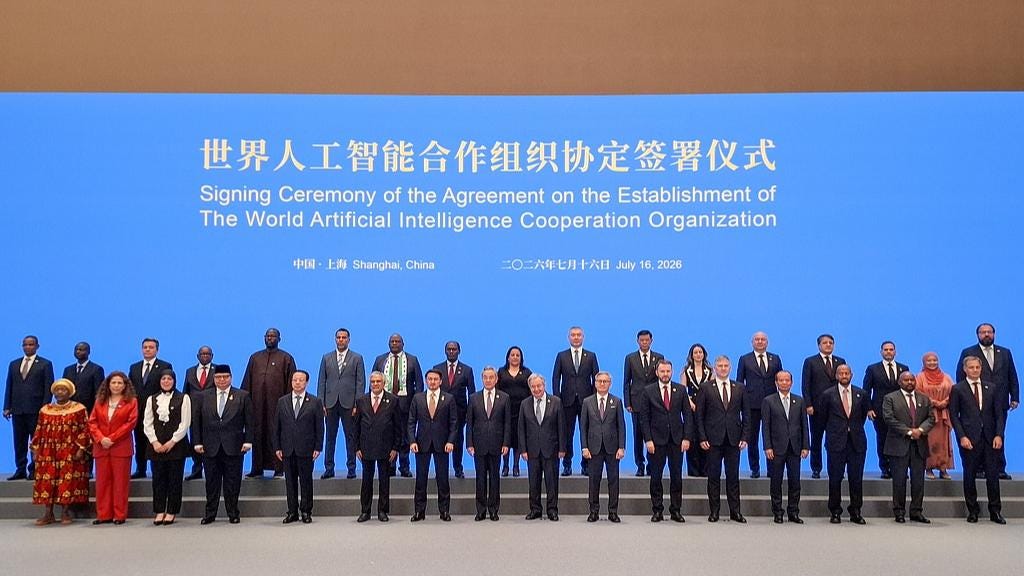
The emphasis shifted from founders to governments, from products to governance and from corporate competition to national capability.
The contrast was difficult to ignore. In the United States, the most visible AI narrative remains predominantly entrepreneurial and corporate. China’s official narrative is more national and institutional. These are not absolute distinctions: American government policy plays an important role in technological development, just as Chinese private companies remain essential sources of innovation. The two systems place their narrative and strategic weight in different places.
Across the Pacific, the United States continues to draw much of its strength from entrepreneurial energy, private investment and the remarkable ability of companies to innovate at extraordinary speed. China increasingly speaks through long-term planning, state capacity and institutional coordination.
These are more than competing technology strategies. They represent different ways of organising progress, distributing authority and imagining the future.
The Quarrel Around the Machines
Listening to these competing narratives, I found myself paying less attention to the machines themselves and more attention to the conversation surrounding them.
Public debate increasingly resembles a quarrel around the machines, although the machines themselves remain silent. Governments debate standards. Companies compete for talent and investment. Investors measure opportunity. Media narratives amplify each breakthrough as though the next model alone will determine the future.
Artificial intelligence has become the language through which nations express strategic ambition and corporations pursue influence. It has also become a screen upon which societies project their anxieties about power, employment, security and decline.
Much quieter questions remain in the background. Every advanced model depends upon vast networks of data centres requiring electricity, water, land and resilient transmission systems. Semiconductor supply chains stretch across continents. Governments announce governance frameworks while still wrestling with implementation.
Questions surrounding infrastructure, funding, education, regulatory capacity and public trust receive far less attention than the release of the next frontier model, although they may ultimately shape the success of artificial intelligence far more profoundly.
There is also a more fundamental question: how will the benefits of that success reach those at the bottom of the economic pyramid?
The Measure of Progress
As I reflected on the conversations from Tokyo, Nairobi, Dubai and New Delhi, one observation kept returning to me. None of the people I met asked which company would build the world’s most capable model.
They wanted to know whether they could build a business, educate their children, find meaningful work and retire with dignity. Their questions have remained remarkably consistent even as the technologies surrounding them evolve at extraordinary speed.
The longer I sat with those conversations, the more I felt that the real transition taking place was larger than technology alone. Artificial intelligence is undoubtedly testing the capabilities of machines. At the same time, it is testing the resilience of institutions, the maturity of leadership and the ability of societies to translate extraordinary innovation into ordinary human progress.
A model may achieve extraordinary results on a benchmark while the society around it struggles to provide reliable electricity, useful education or economic security. A country may lead in computing power yet fail to persuade its citizens that technological progress is improving their lives.
The ultimate measure of artificial intelligence may therefore lie not only in what the technology can accomplish, but in whether institutions can direct that capability toward human purposes.
What the Mirror Reveals
When I think back to these past few months, I remember very little about benchmark scores or product announcements.
I remember the retired executive searching for purpose beyond success. I remember the young graduate wondering where opportunity might lead. I remember parents quietly calculating household expenses while imagining a better future for their children.
Those faces have stayed with me far longer than the specifications of any model.
A mirror has never been responsible for the image it reflects. Its quiet purpose is simply to reveal what is already standing before it.
Artificial intelligence may become one of the most remarkable technologies our civilisation has ever created. Yet the more enduring question concerns something far older than technology itself.
As we look into that mirror, we are also looking at our institutions, our priorities, our ambitions and our capacity for wisdom. The reflection before us is not only the future of the machine.
It is the future we are choosing for ourselves.
Saliya Weerakoon

Saliya Weerakoon is an executive, entrepreneur, columnist, and public speaker with 30 years of experience in Asia Pacific and Middle Eastern markets. Saliya is a fellow at econVue. He lives in Colombo, Sri Lanka and…