


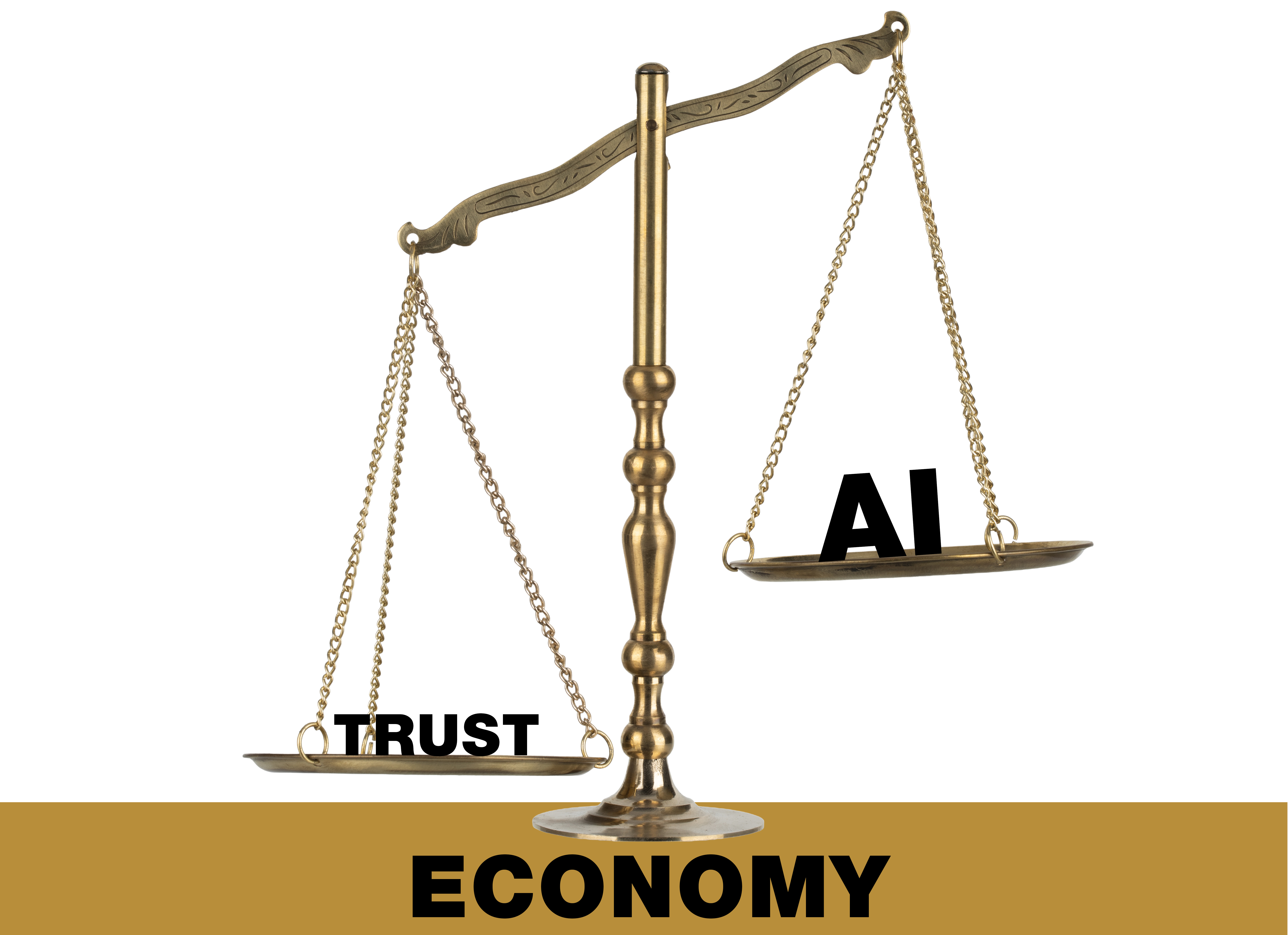
Editor’s Note: In this VuePoint, Kathleen Graham examines one of the most under-appreciated costs of the AI era: the rising burden of verification. As generative AI makes images, documents, voices, and even institutional records easier to manipulate, trust itself becomes a form of economic infrastructure. Graham’s central insight is that AI does not simply reduce the cost of producing information; it also raises the transaction cost of determining whether information is genuine. The question is no longer simply whether AI can produce more content or accelerate analysis, but whether companies, markets, courts, and individuals can still verify what is real.
“Trust, but verify” is a Russian proverb that became famous globally when President Ronald Reagan made it his signature phrase in discussions with Soviet leader Mikhail Gorbachev during the negotiations that led to the 1987 signing of the Intermediate-Range Nuclear Forces Treaty. When Gorbachev once asked why Reagan repeated the phrase at every meeting, Reagan replied, “I like it.”[1]
Many others have agreed. The phrase has endured because it captures a standard method for working effectively with others: one could place reliance on the character, ability, strength, and truthfulness of another person, while also verifying that the person, the promise, and the promised action were genuine at every step of an agreement.
Today, that standard is under pressure. With the advent of generative AI, images, documents, voices, videos, and other materials can now mimic actual people and their creations with extraordinary precision. It is increasingly difficult to know whether what one is seeing, hearing, or reading is real — or a deepfake. Hany Farid, one of the world’s leading deepfake experts, has recently warned that even he can no longer reliably distinguish between real and manipulated media created by sophisticated generative AI models.[2]
The questions now become unavoidable: How does one trust in a world where the real and the manipulated version of the real appear identical? How does one verify in a world where the real and the manipulated version of the real appear identical? The distinction matters because only the real person, institution, or system can deliver what was promised. In economic terms, AI is not only changing what can be produced; it is changing what must be verified before people, firms, and institutions can act.[3]
It is useful here to distinguish between manipulation and persuasion. Merriam-Webster defines a deepfake as a digital image, video, voice, or other material that has been convincingly generated or altered to misrepresent someone as doing or saying something that was not actually done or said.[4] The American Psychological Association (APA) defines manipulation as behavior designed to exploit, control, or otherwise influence others to one’s advantage.[5] Misrepresenting what someone said or did is manipulation.
Persuasion is different. The APA defines persuasion as an active attempt by one person to change another person’s attitudes, beliefs, or emotions about an issue, person, concept, or object.[6] Persuasion may try to change someone’s mind, but it does not require falsifying reality. Manipulation does.
This article first provides examples of what generative AI models are now producing and why they raise urgent questions about verification. It then turns to ways individuals, companies, and institutions can begin to verify in this new AI era so that trust can be rebuilt. The uncomfortable reality is that moving through this period may require more work, more caution, and more time than earlier methods of verification required.
However, our current situation is not the first era in which technological disruption, disasters, political realignment, and social confusion have made it difficult to distinguish what is true from what is false. The 1930s brought rapid technological change — turbojet engines, commercial aviation, frozen foods, radio as mass media, sound films, color films, stereophonic sound, trans-Pacific flight, airmail across the Atlantic, and the first regular high-definition television service.[7]
At the same time, the world endured the Dust Bowl, severe famines in the Soviet Union and China,[8] catastrophic floods in China, and the Great Depression. Major political realignments also occurred with the rise of the Nazi Party, the Spanish Civil War, the founding of Saudi Arabia, Gandhi’s movement in India, and the wars between China and Japan.[9]
It was an era in which the world felt topsy-turvy. Groucho Marx captured this mood in Duck Soup with the line, “Who are you going to believe, me or your own eyes?” The joke worked because people understood the dilemma: should one trust one’s own perceptions, or accept another version of reality offered by someone else?[10]
That dilemma is very close to the situation that we face now at the beginning of the AI era. Once again, we must do the extra work of critical thinking,[11] scrutinizing information, and refusing to accept appearances at face value. Ronald Reagan said, “The future doesn’t belong to the fainthearted; it belongs to the brave.”[12]
We choose to be brave...and here are some ways to rebuild the habits and systems that allow us to verify.
The New Verification Burden
The scale of AI-generated content is already enormous. A Graphite/Originality.ai study found that by late 2025, 52% of newly published online articles were AI-generated, up from roughly 10% in late 2022.[13] Ahrefs independently found that 74.2% of 900,000 newly created web pages contained AI-generated content. The “50/50 split” has become the new normal. AI content growth may have plateaued as a share of new web content, but total content production is still rising. There is simply more of everything.[14]
The consequences are not abstract. AI-generated mushroom-foraging guides on Amazon have reportedly contained potentially lethal misidentifications.[15] AI medical advice proliferates without peer review. AI-generated political imagery — from fabricated campaign images to false disaster photos — can spread faster than fact-checkers can respond.
When visual evidence becomes unreliable, democratic participation suffers. Real musicians and artists lose royalties to AI content stuffing. Human writers compete with AI content farms. Major institutions risk credibility damage when hallucinated content is published under their name, as happened when the Chicago Sun-Times published a summer reading list in which 10 of 15 recommended books were AI-generated hallucinations.[16]
The psychological effects are also significant. A 2026 Malwarebytes report on AI scams found that nearly 9 in 10 people say they can no longer tell what is real from AI.[17] The result is a persistent unease: the “black box effect” of not knowing whether what one is encountering is authentic.[18]
The corporate repercussions are already visible. The Spring 2026 issue of Chicago Booth Review was titled “Going Deep Inside the AI Revolution.” Its introduction page gives several dramatic recent examples: X CEO Linda Yaccarino resigned in July 2025 after the platform’s Grok chatbot produced pro-Hitler and antisemitic messages; McDonald’s hiring chatbot exposed the personal information of 64 million job applicants after researchers discovered that anyone could access a test administrative account by typing “123456” as the password; Lenovo’s AI-powered customer-support chatbot gave unauthorized access to support systems after a malicious prompt instructed the AI to ignore its own security protocols.[19] Adding to the concern, Matt Robinson’s article in that same issue explores how “our understanding of how AI ‘reasons’ is startlingly limited.”[20]
The Chicago Booth Review editors of that edition posed the question: “AI is a technology created by people and driven by human knowledge, yet we do not fully understand how it works. If something goes wrong — if a chatbot provides dangerous answers, overshares sensitive data, stores information improperly, or behaves deceptively — how can we ensure that AI is safe to deploy?”[21]
There are financial repercussions as well. Companies are increasing their AI budgets, but many are still seeing lackluster productivity gains while computing power and usage costs rise, as revealed by a 2026 Bain & Company survey.[22] A Sage/IDC survey of 2,275 senior financial decision-makers found that finance leaders are spending nearly 13 hours a week validating AI-generated outputs.[23] Verification is expensive. AI can create more work than it saves. Trust (or the lack thereof), not capability, may become the primary constraint on AI adoption.
There are also legal risks. AI transcription, meeting-summary, screen-recording, and collaboration tools can create unintentional digital paper trails. These records may expand what is discoverable in litigation or accessible to regulators. In 2023, 62% of global general counsel reported new issues related to collaboration platforms, chat apps, file shares, and cloud systems at work.[24]
Courts are also confronting numerous AI-generated legal errors, including a case in which lawyers on both sides submitted briefs to the court that relied on AI-generated filings containing fabricated citations, resulting in the judge dismissing the case, sanctioning the lawyers on both sides, and barring two of them from the court for two years.[25]
Finally, there are resource and infrastructure risks. Every AI query incurs costs: chips, data centers, electricity, water, copper, and other critical inputs.[26] AI detectors can help, but they are imperfect, especially for shorter texts.[27] McKinsey’s 2026 State of AI Trust report found that security and risk concerns remain the top barrier to scaling agentic AI, while active mitigation lags behind risk awareness across nearly every AI risk category.[28]
Together, these scenarios are creating the new verification tax burden. AI may reduce the cost of producing content, analysis, and synthetic media, but it also raises the cost of knowing what is real.
Trust Is Economic Infrastructure
Trust is not soft and it is not new. Trust is economic infrastructure.
Societies and individuals with higher levels of interpersonal trust consistently outperform their lower-trust counterparts on economic and institutional measures. Higher trust is associated with stronger economic growth, better institutions, lower transaction costs, higher investment rates, and more reliable contract enforcement.[29]
Participation in financial markets depends heavily on generalized trust. Collaboration and governance are easier when parties do not have to rely on lengthy contracts, expensive enforcement, and constant suspicion.[30]
Economists have long understood this connection. Nobel Laureate Kenneth Arrow famously observed that “virtually every commercial transaction has within itself an element of trust, certainly any transaction conducted over a period of time.”[31]
University of Chicago Professor Ronald Coase’s pioneering papers—The Nature of the Firm in 1937[32] and The Problem of Social Cost in 1960[33]—led to his receiving in 1991 the Nobel Prize for Economics, for “his discovery and clarification of the significance of transaction costs…[in] the functioning of the economy.”[34]
Nobel Laureate Oliver Williamson built on Coase’s research by proving that “institutions are susceptible to analysis,” which can be performed by (1) Keep it simple, by focusing on the main issue; (2) Get it right, which “includes translating economic concepts into accurate mathematics with further operations correctly performed and verified;” (3) Make it plausible, by “describing human actors in (reasonably) veridical ways and maintaining meaningful contact with the phenomena of interest (contractual or otherwise);” (4) Derive refutable implications from the veridical human actors descriptions—i.e., “their cognitive, self-interestedness, and feasible foresight respects” and then “submitting this data to empirical testing.”[35]
Arrow, Coase, Williamson, and other new institutional economists have proven why transaction costs matter: when the costs of search, bargaining, monitoring, and enforcement rise, the result is that markets, firms, and humans change their behavior accordingly.[36]
AI-generated uncertainty imposes a direct economic burden on transaction costs, because it causes transaction costs to rise due to the the increased need for verification.
Trust saves money. When people observe that behavior is driven by external incentives rather than genuine intent, they update their beliefs about others’ trustworthiness downward. Changed incentives change behavior. Changed behavior changes beliefs. The result can become a self-reinforcing spiral toward distrust, lower productivity, and higher costs.[37]
A lack of trust affects economic stability through higher transaction costs, reduced investment, lower consumer spending, and the erosion of institutional credibility.[38] If a counterpart does not trust you, resistance is almost certain.[39] Businesses thrive on the cumulative trust their stakeholders place in them, as is true of governments.[40]
Hany Farid has warned that today’s deepfakes have become part of the background of modern life: scammer tools, social-media weapons, video-call impersonations, and voice clones that can mimic a child calling a parent in distress. In this environment, speed is the point. By the time a fake is disproved, the damage is often already done.
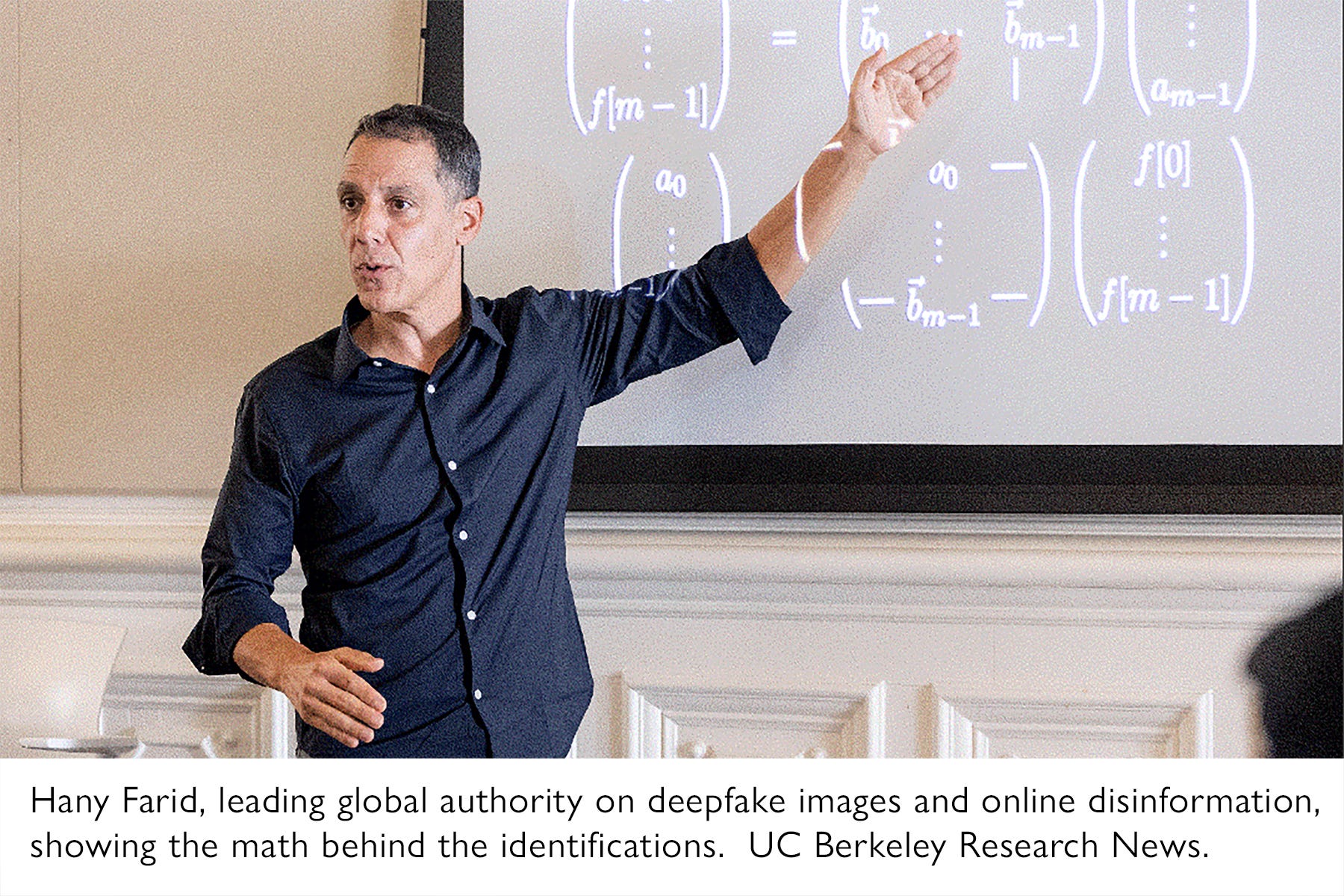
Farid emphasizes that much of what we call artificial intelligence is built on human labor: human annotation, human judgment, human selection, and human correction. Human origin matters for education, business, law, and governance. Students are already using these tools. Professionals are already using these tools. The question is not whether AI will be present, but what people need to learn in a world where these tools are always nearby.
He says that what we have lived with for the past 20 years in social-media disinformation is now being amplified by generative AI: more sophisticated bots, fake images, fake video, fake voices, and fake evidence. His advice: if we want a world where evidence still counts, we must rebuild the rules of liability and go after the choke points that make digital deception cheap and profitable.
Farid concludes that the trust infrastructure needs to be rebuilt for the age of generative AI. His view is that the issue extends far beyond social media. Courts must decide how to trust evidence in civil, criminal, and national-security cases. Companies must decide how to trust AI systems embedded in operations. Governments must decide how to trust AI-enabled systems that may eventually touch critical infrastructure.[41]
Clearly, something fundamental is shifting in society. Decisions made over the next few years will define the future of our economy, of our institutions, and of our quality of life.
Ten Ways to Verify in an AI-Generated World
1. Meet new people in person whenever possible. Verify that the person you met is who they say they are by meeting others who can confirm their identity and background. Do not rely only on online information. When appropriate, establish a safe word, code phrase, or shared fact for future verification. There is an additional benefit from meeting in person: Nicholas Epley, professor of behavioral science at the University of Chicago Booth School of Business and author of Mindwise and A Little More Social, has shown that in-person conversations build connection, relationships, and information-sharing more effectively than online interaction.[42]
2. Minimize and protect the amount of personal information you keep online. This practice includes checking your information on LinkedIn, Facebook, and other social platforms. The more public information available about you, the easier it becomes for someone to impersonate you or manipulate others using your identity.
3. Do not use the same email addresses or phone numbers for financial accounts and social media. Using different personal, financial, and public-facing contact information (email addresses, phone numbers, etc.) reduces the risk that one compromised source can be used to access another. Double-check long-standing accounts to verify that crucial information hasn’t been used recently on social media.
4. Do not click on links reflexively. Look up the information separately through a trusted source or official website. Carefully double-check logos, company names, and other info provided, especially when these fakes look legitimate and you are in a hurry.
5. If someone you do not know calls you, hang up and call back through a verified number. Use a main number or official contact source whenever possible.
6. If someone you do not know emails you, check them carefully. Confirm through another person or independent channel that the sender is real before responding, sending money, sharing information, or clicking anything.
7. Treat disinformation security as part of cybersecurity. It’s important that organizations focus on whether systems are technically secure and whether inaccurate or manipulated information is leaking into systems, data, decisions, and thought processes. Critical thinking and evergreen premortems are some of the tools that can help expose and minimize disinformation security issues.
8. Include verification costs in AI return-on-investment calculations. AI may improve at computer-science speed, but the production of final products and services still require humans and capital, which operate at different speeds and schedules. AI also does not yet reliably assess overall enterprise risk, set strategy, protect governance, build relationships, or perform business development. These roles remain human strengths. Moreover, AI depends on capital: money, land, energy, data centers, chips, water, rare earth minerals, machines, and robots. These human and capital inputs move at a different cadence from AI and are potential substitutions for AI, sometimes at a lesser overall cost.[43] To ensure accurate AI cost-benefit analysis, the actual and potential costs of training, monitoring, disinformation risk, legal risk, infrastructure risk, substitution analysis, and contingency planning are necessary elements.
9. Help shape the policies that will rebuild trust. To paraphrase Hany Farid, something is clearly shifting in the world. It is therefore time to think seriously about the future and what appropriate policies are required now. The more input that comes from individuals, businesses, professional associations, universities, and governments, the more likely it is that safeguards for the AI era will cover real-world contingencies.
10. Focus on changing the infrastructure that makes deception cheap and profitable. Farid has described a world drowning in AI slop: fake war videos, fabricated political robocalls, false celebrity endorsements, AI-generated kidnapping scams, fake job applicants, fabricated identities, fake podcasts, [44] and manipulated images that spread faster than they can be debunked. Going after individual pieces of content is not enough as the reward mechanism is still in place. The supporting infrastructure that profits from these manipulations should be the target of laws, liability rules, platform responsibilities, and enforcement protocols designed to reduce the incentives now weaponizing generative AI against individuals, companies, and society. Changed incentives do change behavior.
Conclusion

This new AI era can be phenomenal. AI can do repetitive or lengthy work faster, freeing humans to build ideas into reality more quickly. Humans still have sustainable competitive advantages: creative thinking, judgment, relationship-building, values, purpose, and the ability to look around the corner. The “creative leap” — the flash of insight through which a new idea is born — remains deeply human.
Technology can accelerate analysis and clarify uncertainty, but it cannot replace the human purpose, values, and judgment behind decisions. The best path forward is not AI instead of humans, but AI as a trusted adviser: improving the speed, scale, and quality of decisions while keeping humans firmly in charge of the “why.”[43]
“Trust, but verify” was once a useful rule. In the AI era, the question is harder: how now to verify? The answer will determine the strength of our trust infrastructure and, therefore, the quality and level of our future economic and institutional life.
If the economy is a skyscraper, trust is the steel framework. With brave human effort and AI’s speed, depth, and support, our future economy will stand tall.
About the Author
Kathleen Graham

Kathleen Graham is an expert in human capital—the economic value of individuals, groups, or workforces that contribute to organizational success. Renowned for her accurate forecasts of employment and…
Footnotes
[1] National Air and Space Museum, Smithsonian. (n.d.). INF Treaty Signing - Trust, But Verify. Air and Space Museum. https://airandspace.si.edu/multimedia-gallery/inf-treaty-signing-trust-verify
[2] Saslow, E. (2026, June 14). The world’s leading deepfake expert no longer trusts his own eyes. https://www.nytimes.com/2026/06/14/us/ai-deepfake-hany-farid.html [paywall]. Reprinted: (2026, June 16). https://www.seattletimes.com/nation-world/the-worlds-leading-deepfake-expert-no-longer-trusts-his-own-eyes/
[3] Catalini, C., Hui, X., Wu, J. (2026, February 25). Some Simple Economics of AGI. General Economics (econ.GN). https://doi.org/10.48550/arXiv.2602.20946
[4] Merriam-Webster. (n.d.). Deepfake. In Merriam-Webster.com dictionary. https://www.merriam- webster.com/dictionary/deepfake
[5] American Psychological Association. (n.d.). Manipulation. In APA dictionary of psychology.https://dictionary.apa.org/manipulation
[6] American Psychological Association. (n.d.). Persuasion. In APA dictionary of psychology. Retrieved July 10, 2026, from https://dictionary.apa.org/persuasion
[7] Johnston, M. (2025, November 12). Timeline of the 1930s. Encyclopedia Britannica. https://www.britannica.com/topic/Timeline-of-the-1930s
[8] Herre, B., et al. (2025, March). Famines. Our World in Data. https://www.ourworldindata.org/famines
[9] Forgeard, V. (2024, April 6). 1930s Timeline: Key Moments from a Transformative Decade. BrilliantIO.com. https://brilliantio.com/1930s-time-line
[10] Thoughts in Harmony. (2024, August 1). Decoding Groucho Marx’s quote: Who are you going to believe, me or your own eyes? https://rhodetrips2110.wordpress.com/20204/08/01/decoding-groucho-marxs-quote-who-are- you-going-to-believe-me-or-your-own-eyes-from-duck-soup
[11] Critical Thinking. In Wikipedia. https://en.wikipedia.org/wiki/Critical_thinking.
[12] Ronald Reagan Quotes. (n.d.) The future doesn’t belong to the fainthearted. Reagan Foundation. https://www.reaganfoundation.org/ronald-reagan/quotes/the-future-doesn’t-belong-to-the-fainthearted-it
[13] SlopDetector. (2026, February 12). The rise of AI slop. https://slopdetector.org/blog/rise-of-ai-slop
[14] Law, R., Guan, X., & Soulo, T. (2025, May 19). 74% of new webpages include AI content. Ahrefs. https://ahrefs.com/blog/what-percentage-of-new-content-is-ai-generated
[15] Mollman, S. (2023, September 3). Mycologists warn of life or death consequences as foraging guides written with AI chatbots crop up on Amazon. Fortune. https://fortune.com/2023/09/03/ai-written-mushroom-hunting- guides-sold-on-amazon-potentially-deadly/
[16] Rosenblatt, K. (2025, May 21). Chicago Sun-Times admits summer book guide included fake AI-generated titles. NBC News. https://www.nbcnews.com/tech/tech-news/chicago-sun-admits-summer-book-guide-included-fake- ai-generated-titles-rcna208325
[17] Malwarebytes. (2026, June). Face value: How AI is reshaping trust, identity, and scams. Malwarebytes. https://malwarebytes.com/ai-scams?utm_source=iterable&ut
[18] Jones, P. (2026, January 2). The psychology behind our anxiety toward black box algorithms. Psy Post. https://www.psypost.org/the-psychology-behind-our-anxiety-toward-black-box-algorithms
[19] Weitzman, H. & Lambert, E. (2026, Spring). Going deep inside the AI revolution [Editorial]. Chicago Booth Review. https://www.chicagobooth.edu/review/spring-2026
[20] Robinson, M. (2026, Spring). Can we break open AI’s black box? Chicago Booth Review. https://www.chicagobooth.edu/review/spring-2026
[21] Weitzman, H. & Lambert, E. (2026, Spring). Going deep inside the AI revolution [Editorial]. Chicago Booth Review. https://www.chicagobooth.edu/review/spring-2026
[22] Heric, M. , Doddapaneni, P., & Debarre, A. (2026, June 1). Your AI budget is growing. Your returns aren’t. Here’s why. Bain & Company. https://www.bain.com/insights/your-ai-budget-is-growing-your-returns-arent-heres-why/
[23] Permenter, K. (2026, June). The emerging economics of AI in finance. IDG-Sage. https://blog.insightful.accountant.com/sage-releases-idc-whitepaper-emerging-economics-of-ai-in-finance
[24] Dinzeo, M. (2024, August 12). AI tools creating digital paper trails that could haunt companies in court. ALM Law. https://www.law.com/corpcounsel/2024/08/12/ai-tools-creating-digital-paper-trails
[25] Tangermann, V. (2026, June 11). Furious judge cancels entire trial after finding out lawyers on both sides used AI. Futurism. https://futurism.com/artificial-intelligence-judge-cancels-trial
[26] Brown, M. (2026, Summer). How many questions can the world afford to ask AI? Chicago Booth Review. https://www.chicagobooth.edu/review/summer-2026
[27] Jabarian, B. & Imas, A. (2026, Spring). Data points: Do AI detectors work well enough to trust? Chicago Booth Review. https://www.chicagobooth.edu/review/spring-2026
[28] Asaftei, G. & Roberts, R. (2026, March 25). State of AI trust in 2026: Shifting to the agentic era. McKinsey. https://www.mckinsey.com/capabilities/tech-and-ai/our-insights/tech-forward/state-of-ai-trust-in-2026- shifting-to-the-agentic-era
[29] Grun von Jolk, R. (2026, May 5). The economics of trust. Psychology Today. https://www.psychologytoday.com/us/blog/maximizing-relationships-and-happiness-in-life/202604/the- economics-of-trust
[30] Kalish, I., Wolf, M., & Holdowsky, J. (2021, May 20). The link between trust and economic prosperity. Deloitte. https://www.deloitte.com/us/en/insights/topics/economy/connecting-trust-and-economic-growth
[31] Leblang, D., Smith, M., & Wesselbaum, D. (2022, November). The effect of trust on economic performance and financial access. Economics Letters, 220; 110884. https://doi.org/10.1016/j.econlet.2022.110884
[32] Coase, R. H. (1937). The Nature of the Firm. Economica, 4(16), 386–405. https://doi.org/10.2307/2626876
[33] Coase, R. H. (2013). The Problem of Social Cost. The Journal of Law & Economics, 56(4), 837–877. https://doi.org/10.1086/674872
[34] The University of Chicago Law School. (n.d.). A Nobel Winner. https://www.law.uchicago.edu/lawecon/coaseinmemoriam/nobel
[35] Williamson, O. (2025). Transaction Cost Economics. In C. Menard & M.M. Shirley (Eds.), Handbook of New Institutional Economics (2nd ed., pp. 48-71). Springer. https://doi.org/10.1007/978-3-031-50810-3_4
[36] Menard, C. & Shirley, M.M. (2025). Handbook of New Institutional Economics (2nd ed., pp. 1-21). Springer. https://doi.org/10.1007/978-3-031-50810-3_4
[37] Ortiz-Ospina, E. (2024, April) Trust: How does interpersonal trust differ across societies? Our World In Data. https://ourworldindata.org/trust
[38] North, D. C. (1984). Transaction Costs, Institutions, and Economic History. Zeitschrift Für Die Gesamte Staatswissenschaft / Journal of Institutional and Theoretical Economics, 140(1), 7–17. http://www.jstor.org/stable/40750667
[39] Program on Negotiation. (2026, February 5). Overcoming resistance: The influence equation. Harvard Law School. https://law.harvard.edu/pon
[40] Williamson, O. E. (1998). The Institutions of Governance. The American Economic Review, 88(2), 75–79. http://www.jstor.org/stable/116896
[41] Sullivan, E. (2026, March). A deepfake can ruin you before breakfast. Scientific American. https://www.scientificamerican.com/article/deepfakes-are-getting-faster-than-fact-checks-says-digital-forensics-expert
[42] Epley, N. (2026, Spring). Is conversation magical?. Chicago Booth Review. https://www.chicagobooth.edu/review/spring-2026
[43] Nelken, I. & Graham, K. (2026, May 1). The rise of the humans and their AI agents. The HQ Companies. https://www.thehqcompanies.com/pdf/The-Rise-of-the-Humans-and-Their-AI-Agents.pdf
[44] Thorne, E. (2026, July 8) A fave new podcast isn’t real. LinkedIn News. https://www.linkedin.com/linkedin-news