The Underwriters of Fortune
How Insurance Turns Uncertainty into Growth
The boundary between the insurable and the uninsurable is the line between expansion and stagnation.
Risk in Motion
Could the automotive industry have grown into a world of roughly 1.5 billion cars without the parallel growth of automobile insurance?1 The answer is almost certainly not. Even when automobiles were relatively rare, accidents were common enough to create a new category of financial and legal risk. But the insurance industry quickly found a solution to the problem.
Automobile insurance appeared almost as soon as the car became a commercial reality: Travelers Insurance issued an automobile policy in 1897, while Massachusetts became the first state to require compulsory automobile liability insurance in 1927. 2 The automobile transformed mobility, but insurance helped transform the automobile into a mass-market system.
Automotive technology and manufacturing expertise transformed individual mobility in the US a hundred years ago. But wide adoption required something more: a way to share the risks of that mobility. The same pattern appeared in aviation: airplanes transformed distance, but aviation insurance helped make commercial air travel financeable, governable, and scalable.3
The Link Between Insurance and Economic Growth
What is true of the automobile industry is true across the economy. Insurance is not just a financial product; it is the hidden infrastructure, the secret sauce of American capitalism. It converts uncertainty into calculable risk, supports home buying, healthcare, and credit formation. It allows firms and entrepreneurs to take on risks while protecting directors and fiduciaries and helps explain why the US economy is unusually entrepreneurial and litigious at the same time.
Insurance is infrastructure, the scaffolding that allows households, entrepreneurs, and corporations to take risks that generate greater growth. Banks store capital, but insurance stores risk.
Almost every economic activity we undertake today is insured. From trade and commerce, aviation, logistics, savings and mortgages, to health and life spans, are all impacted by insurance and the cost of insurance. It is the financial shock absorber of American capitalism. This can be seen clearly when insurance is withdrawn. In wildfire, hurricane and flood zones, local dynamism in the housing market can collapse.
The boundary between the uninsurable and the insurable is the line between expansion and stagnation. Every time societies find a way to insure against a new category of risk, they enlarge the set of economic activities individuals and businesses are willing to undertake. In the Strait of Hormuz, risk did not remain geopolitical. It became insurable, then expensive, then in some cases nearly uninsurable, and the cost has moved through the global economy. Insurance prices risk in the open market.
Similar to limits on fund redemptions, insurance withdrawals are often signs of structural economic stress. Recent claims data suggest that the protection homeowners thought they had is becoming less reliable in some markets. In Texas, nearly 47% of homeowners-insurance claims in 2024 were reportedly closed without payment, up from 35% in 2016 and above the national average of 42%. As the US Treasury has reported, homeowners insurance costs are rising —and availability is worsening—especially in high climate-risk areas in Florida and California.4
At the same time, it is a mark of civilizational progress that a social compact allows us to share the risks of cancer, car crashes, hurricanes, and premature death with one another. It is an incredible innovation that has been with us since the Code of Hammurabi, but never has it been so widespread across so many sectors. It has girded our current prosperity and become the institutional expression of social solidarity.
A look at the numbers: net premiums in the US totaled $1.76 trillion in 2024, with property/casualty at $932.5 billion and life/annuity at $822.6 billion.5 Direct premiums were even larger, about $2.14 trillion. Health insurance alone reported about $1.2 trillion in direct earned accident and health premium in 2024.
Insurance companies are also major institutional investors. Collectively, insurers manage $42 trillion in invested assets worldwide, making them among the largest institutional investors in the global financial system.6
Precisely because insurance usually operates quietly in the background, it receives remarkably little attention from economists outside the industry itself. We only notice insurance when premiums spike, claims are denied, or coverage disappears.
An Economic Theory of Insurance
Economist Douglass North shared the 1993 Nobel Memorial Prize in Economic Sciences for work showing that institutions matter to economic performance. At the center of his argument was the idea that institutions reduce uncertainty, making exchange, cooperation, and long-term growth possible.7
Contracts that facilitate exchange and property rights encourage investment. Beyond legal mechanisms to resolve disputes however, insurance reduces the financial consequences of unforeseen events by allowing uncertainty to be shared across millions of policyholders. It is much more than a financial product; it is infrastructure.
Insurance belongs alongside banking, property rights, and contract law as one of the foundational institutions of economic development.
Innovation never stops, and institutions always struggle to keep up with technological advancements. As the AI economy grows and diversifies, insurance against cyberattacks and malicious uses of AI models will also need to evolve. Tomorrow’s frontier may include autonomous AI systems, robots, lunar mining operations, and companies such as SpaceX as they venture farther out into the solar system. As the economy grows more technologically complex, so too do its insurance needs, creating opportunities for new financial products and new forms of risk-sharing.
The History of Insurance
Historically, marine insurance enabled trade, fire insurance enabled cities, liability insurance enabled industrialization. Automobile and aviation insurance enabled two of the great transportation revolutions of the twentieth century. Every great era of expansion depended upon new forms of risk sharing.
Unlike many advanced countries, the US relies heavily on private insurance markets to manage healthcare risks, leading to both innovation and higher costs. But as the COVID pandemic showed, some shocks exceed the capacity of even sophisticated insurance systems. Companies are mostly left to manage supply-chain and geopolitical disruptions on their own.
Every great era of expansion required a new form of insurance:
Insurance is much older than most people realize:
Ancient Trade
Merchants in ancient Mesopotamia and later Babylon developed arrangements where lenders would forgive a loan if a ship or caravan was lost. Elements of this appear in the Code of Hammurabi (around 1750 BC). That idea remains at the heart of insurance today.8
The ancient Greeks and Romans developed more sophisticated risk-sharing arrangements. Roman burial societies functioned as an early form of life insurance. Members paid into a common fund that covered funeral expenses and supported surviving family members.9
The real breakthrough occurred during the commercial expansion of medieval Italy. In the 13th and 14th centuries, merchants in cities such as Genoa and Venice began writing contracts that look remarkably familiar today. Separate insurance contracts were created to protect ships and cargo. This was revolutionary. Before insurance, a single storm could bankrupt a merchant. After insurance, trade became scalable. Marine insurance was one of the essential technologies behind the rise of global commerce.10
Lloyd’s and the Age of Empire
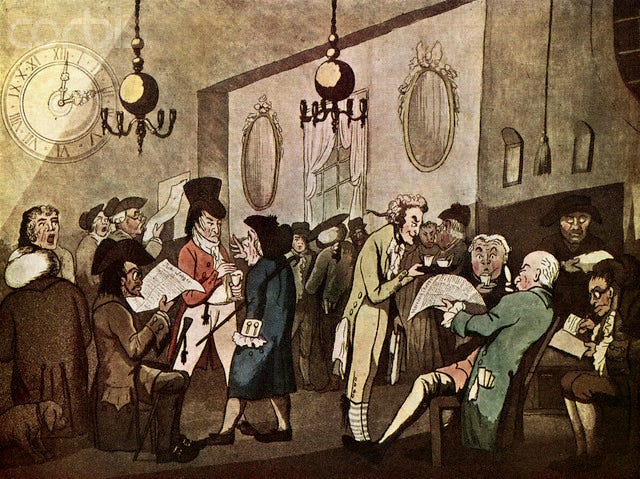
The next great leap occurred in 17th-century London. Merchants, shipowners, and financiers gathered at Lloyd’s Coffee House to exchange information about ships and voyages. Investors literally wrote their names underneath portions of risk they were willing to assume, hence the term underwriter. This eventually became Lloyd’s of London.11
The British Empire was not merely a naval achievement. It was also an insurance achievement. Without marine insurance, global trade routes would have been far more dangerous and capital-intensive. And less travelled.
Fire Insurance and the Growth of Cities
The next breakthrough followed the Great Fire of London which destroyed more than 13,000 houses and left an estimated 100,000 people homeless, creating the conditions for organized fire insurance to flourish.12 Urbanization required a mechanism to manage catastrophic fire risk. Fire insurance emerged and allowed cities to grow larger and denser. Again, economic expansion followed a new form of insurability.
The same pattern repeated itself in the United States. The Great Chicago Fire of 1871 destroyed more than 17,000 buildings and left roughly one-third of the city's residents homeless.13 The catastrophe accelerated advances in underwriting, building standards, and urban fire insurance, reinforcing the lesson that economic expansion depended not only on engineering and construction, but also on institutions capable of spreading catastrophic risk.
Industrialization
Factories, railroads, and industrial enterprises generated risks that had never existed before. Insurance evolved to absorb them, including casualty insurance, workers’ compensation, and liability insurance. Industrial capitalism expanded.
American Exceptionalism
Unlike many countries, the United States relies heavily on private insurance markets to manage risks associated with life, health, property, liability, retirement, and corporate governance. That reliance has fostered extraordinary innovation but also creates unique vulnerabilities.
The American insurance system is both highly decentralized and systemically important. That combination works well when risks are local but becomes more problematic when risks are national and correlated.
The US regulates insurance largely at the state level, a system that reflects the local nature of many insurance markets. Fire, flood, auto, health, and property risks vary enormously by geography, and state regulators often have a better understanding of local conditions than a distant federal agency would. Yet the same system becomes less well suited to risks that are national or global in character. Private credit exposures, offshore reinsurance structures, affiliated asset management, cyber risk, and climate-driven catastrophe losses do not stop at state borders.
As with data centers, where local permitting decisions now shape national AI capacity, insurance regulation illustrates a broader American challenge: the institutions responsible for governing strategic infrastructure are often fragmented precisely when the risks themselves are becoming more interconnected.
American insurance regulation reveals a recurring weakness in US political economy: nationally strategic systems are often governed through state and local mechanisms.
Global Divergences
Internationally, insurance penetration exceeds 10% of GDP in the US, UK, France, and several other advanced economies, while remaining much lower in many emerging markets.
The OECD reports that total insurance penetration (gross insurance premiums) averaged 6.2% of GDP across OECD countries in 2024 and 5.4% across all reporting jurisdictions.14
The comparison is stark:
Penetration is much lower in many emerging markets. The IAIS also reports that the US is dominant by global premium share: 40% of global gross written premiums in 2023, followed by China at 7.8%, the UK at 6.9%, and Germany, Japan, and France each just over 5%.15
Africa
Insurance penetration across Africa remains low, with Africa’s overall penetration rate around 2.4% in 2023 and non-life penetration around 1.1%, according to the African Insurance Organisation.16 That means risks remain concentrated in families, small businesses, farmers, and governments rather than being broadly pooled. When a drought occurs, a truck is destroyed, or a small factory burns down, there is often no mechanism for spreading the loss.
The contrast with much of Africa is instructive. In advanced economies, debates focus on private credit, regulatory complexity, and insurer balance sheets. In many developing economies, the challenge is more fundamental: insufficient insurance. The result is less investment, less entrepreneurship, and slower economic development. If insurance is a mechanism for sharing risk, it is also a mechanism for expanding opportunity.
What Will Insurance Enable Next?
History suggests that every great technological revolution eventually requires a corresponding revolution in risk sharing. Artificial intelligence may prove no different. Before autonomous agents can negotiate contracts, diagnose disease, manage infrastructure, or operate factories, societies will need institutions capable of underwriting the new risks they create. The next frontier of economic development may therefore depend not only on breakthroughs in computation, but on breakthroughs in insurability.
Conclusion
At its core, insurance reflects one of humanity's oldest and noblest impulses: the recognition that some risks are too great for individuals to bear alone. Insurance shares uncertainty before the fact; charity responds to suffering after the fact.
Economists often describe growth as a function of capital, labor, and innovation. Yet beneath all three lies a less appreciated requirement: the ability to share risk. From the first marine insurance contracts to modern cyber policies, economic progress has repeatedly depended on expanding the frontier of the insurable. The great challenge of the coming decades may not simply be developing new technologies but creating the institutions capable of underwriting them.
Technological progress creates new risks. Institutional progress determines whether those risks can be shared. Economic prosperity depends on both.
The history of economic development can be viewed as the gradual expansion of what societies are capable of insuring. The next question is whether the institutions that store society’s risks are themselves becoming a source of risk based on the quality of the assets they manage on behalf of policyholders.
Lyric Hughes Hale
Lyric Hughes Hale serves as Editor-in-Chief of Econvue, which publishes a newsletter, econVue+. She hosts The Hale Report, a podcast series on global economics. She is Director of Research at Hale Strategic
Part 2
In Part 2, we examine whether the institutions that hold society's risks are themselves becoming sources of risk—and what that could mean for the future of the global economy. Become a subscriber to receive the next installment.
Footnotes & Sources
Hedges & Company, How Many Cars Are There in the World?, updated September 2025, estimates approximately 1.645 billion vehicles globally; the US Energy Information Administration estimated the global light-duty vehicle fleet at 1.31 billion in 2020 and projected continued growth. https://hedgescompany.com/blog/2021/06/how-many-cars-are-there-in-the-world/ ; https://www.eia.gov/todayinenergy/detail.php?id=50096
Travelers, Travelers History, company timeline, notes that Travelers issued an automobile insurance policy in 1897; John G. Ryan, Massachusetts Tries No-Fault, American Bar Association Journal, 1971, notes that Massachusetts became the first state to have compulsory automobile insurance in 1927. https://www.travelers.com/about-travelers/travelers-history ; https://heinonline.org/hol-cgi-bin/get_pdf.cgi?handle=hein.journals/abaj57§ion=110
Travelers, Travelers History, company timeline, also notes that Travelers offered aircraft liability insurance with a full aviation program in 1919. https://www.travelers.com/about-travelers/travelers-history
Matt Zdun and Megan Kimble, Nearly Half of Texas Home Insurance Claims Were Closed Without Payment Last Year, Analysis Finds, Houston Chronicle, June 2025; US Department of the Treasury, Homeowners Insurance Costs Rising, Availability Declining as Climate-Related Events Take Their Toll, January 16, 2025; Federal Insurance Office, Analyses of US Homeowners Insurance Markets, 2018–2022: Climate-Related Risks and Other Factors, January 2025. https://www.houstonchronicle.com/politics/texas/article/texas-homeowner-insurance-claims-closed-20362722.php ; https://home.treasury.gov/news/press-releases/jy2791
Insurance Information Institute, Insurance Industry at a Glance, using S&P Global Market Intelligence data, reports US insurance industry net premiums written of $1.7 trillion in 2024, with P/C insurers accounting for 53.1% and life/annuity insurers 46.9%; P/C net premiums written totaled $932.5 billion. See also Federal Insurance Office, Annual Report on the Insurance Industry, September 2025. https://www.iii.org/publications/insurance-handbook/introduction/insurance-industry-at-a-glance ; https://home.treasury.gov/system/files/311/Final%20FIO%202025%20Annual%20Report.pdf
International Association of Insurance Supervisors, Global Insurance Market Report 2025, reports global insurance-sector data and notes the scale of insurer balance sheets and investments. https://www.iais.org/uploads/2025/12/Global-Insurance-Market-Report-2025.pdf
Douglass C. North, Economic Performance Through Time, Prize Lecture, Nobel Prize, December 9, 1993. North’s framework emphasizes institutions, uncertainty, transaction costs, and economic performance. https://www.nobelprize.org/prizes/economic-sciences/1993/north/lecture/
Library of Congress, Insurance Industry: A Research Guide — Insurance History, notes that concepts related to insurance date to around 1750 BC during the reign of Hammurabi; see also the Code of Hammurabi discussion in historical insurance overviews. https://guides.loc.gov/insurance-industry/history
See historical summaries of Roman collegia funeraticia and burial clubs as mutual-aid arrangements used to cover funeral expenses and support survivors, including USBA, The Unexpected Origins of Life Insurance, September 25, 2025. https://www.usba.com/blog/367/the-unexpected-origins-of-life-insurance
Maristella Botticini, Pietro Buri, and Massimo Marinacci, The Beauty of Uncertainty: The Rise of Insurance Contracts and Markets in Medieval Europe, Journal of the European Economic Association, Vol. 21, No. 6, December 2023, pp. 2287–2326. https://academic.oup.com/jeea/article/21/6/2287/7319353
Lloyd’s, Coffee and Commerce, 1652–1811 and Lloyd’s history materials, describe Edward Lloyd’s coffee house as a center of maritime intelligence and insurance activity. https://www.lloyds.com/about-lloyds/history
London Museum, How the Great Fire Caused a London Housing Crisis, reports that the Great Fire destroyed about 13,200 houses and left about 100,000 Londoners homeless. https://www.londonmuseum.org.uk/collections/london-stories/great-fire-london-housing-crisis/
National Geographic, The Chicago Fire of 1871 and the ‘Great Rebuilding’, reports that the fire destroyed about 17,500 buildings and left about 90,000 people—one in three Chicago residents—homeless. https://education.nationalgeographic.org/resource/chicago-fire-1871-and-great-rebuilding/
OECD, Global Insurance Market Trends 2025, using 2024 data, defines insurance penetration as gross premiums written for direct life and non-life insurance as a percentage of GDP; it reports 6.2% on average among OECD countries and 5.4% across all reporting jurisdictions in 2024, while premiums exceeded 10% of GDP in the US, France, the UK, and some other jurisdictions. https://www.oecd.org/en/publications/global-insurance-market-trends-2025_0d11ecf4-en/full-report/component-3.html
International Association of Insurance Supervisors, Global Insurance Market Report 2024, reports the global distribution of gross written premiums in 2023: United States 40%, China 7.8%, United Kingdom 6.9%, and Germany, Japan, and France each just over 5%. https://www.iais.org/uploads/2024/12/Global-Insurance-Market-Report-2024.pdf
African Insurance Organisation, Africa Insurance Pulse 2024, reports Africa’s overall insurance penetration at 2.4% in 2023 and non-life penetration at 1.1%; OECD, Africa Capital Markets Report 2025, also cites life-insurance penetration in Africa at 2.4% in 2023. https://faberconsulting.ch/files/faber/pdf-news/2024_AIO_e_Final1_Web.pdf ; https://www.oecd.org/en/publications/2025/11/africa-capital-markets-report-2025_a973e07d/full-report/the-role-of-insurance-companies-and-pension-funds-as-institutional-investors-in-african-capital-markets_4889d177.html


