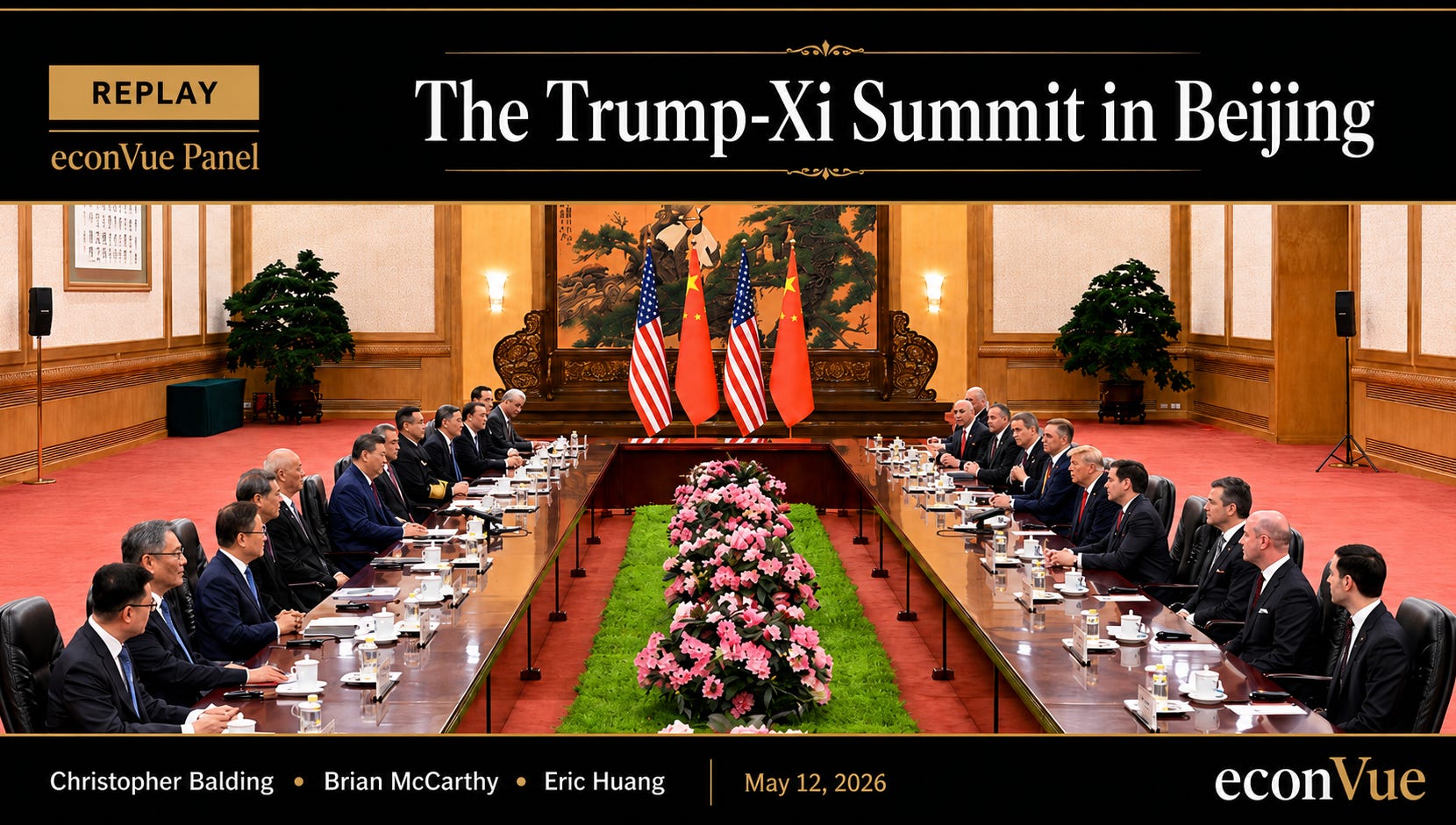
👥 REPLAY: econVue Panel - The Trump-Xi Summit in Beijing
In case you missed this subscriber event with Christopher Balding, Brian McCarthy, & Eric Huang, held May 12, 2026 - (57 mins)
The Trump-Xi Summit in Beijing May 14-15, 2026
❝ We should be partners, not rivals.
–Xi Jinping, May 14, 2026
Stability, or the Appearance of Stability?
On May 12, econVue convened a subscriber panel ahead of the Trump-Xi Summit in Beijing. The panel asked whether the meeting would produce a meaningful reset in US-China relations, or simply a pause in a more profound strategic confrontation.
The discussion featured Christopher Balding, CEO of Siphtor and senior fellow at the Henry Jackson Society; Brian McCarthy, managing principal and chief strategist of Macrolens; and Eric Huang, senior fellow at Hale Strategic and an expert on US-China-Taiwan geopolitics. The conversation was moderated by Lyric Hughes Hale, editor-in-chief of econVue and host of The Hale Report.
The central question became clear early in the discussion: Will the summit produce real stability, or merely the appearance of stability?
Two Leaders, Two Centralized Systems
Panelists agreed that both Washington and Beijing are now operating through unusually centralized leadership systems. Xi Jinping’s China has become far more disciplined around one-man rule, while Trump’s second term has placed China policy in the hands of a smaller and more loyal circle. Christopher Balding argued that Xi’s advisors should not be understood as independent policy voices in the American sense, while Eric Huang described the current CCP system as one of “singular leadership under Xi Jinping.”
Taiwan: The Issue No One Wants on the Table
Taiwan emerged as one of the most sensitive issues. Huang warned that Taiwan does not want to become a topic at the summit. A warmer US-China relationship can sometimes reduce cross-strait tensions, but only if Taiwan is not treated as a bargaining chip. Brian McCarthy said the most important signal to watch would be any shift in US language on Taiwan, especially if Washington moved from not supporting Taiwan independence to actively opposing it.
Iran, Hormuz, and China’s Leverage
The panel also examined how the Iran conflict and the Strait of Hormuz could reshape the summit. McCarthy argued that markets are now focused heavily on Iran and energy risk, and that any real movement toward de-escalation may have to run through Beijing. Karim Pakravan, joining from the audience, emphasized that Iran’s relationship with China is transactional: Beijing has leverage over Tehran, but that does not mean China wants the same outcome as Washington.
Strategic Decoupling Moves From Theory to Policy
Strategic decoupling was another major theme. McCarthy described the emerging US approach as one that allows some continued trade in non-strategic goods while seeking to reduce dependence on China in critical sectors. Balding noted that supply chains are moving out of China, but that the biggest beneficiaries are often countries such as Mexico and Vietnam, rather than the United States. The harder task is securing pharmaceuticals, metals, medical devices, semiconductors, transformers, rare earths, and other critical inputs.
AI and the Battle for Technology Ecosystems
AI added another layer to the discussion. Huang argued that China is advancing quickly in business applications of artificial intelligence and intends to build a competing technology ecosystem. Taiwan sits at the center of that contest, both through TSMC and through the choices its firms will make between US and Chinese systems.
Allies Fear Both Abandonment and Entanglement
The panel also touched on Japan and allied confidence. Richard Katz, joining from the audience, noted that Japan fears both abandonment and entanglement: being left exposed by a US-China deal, or being pulled into conflicts driven by unpredictable US policy.
China’s Economy Beneath the Headline Numbers
On China’s economy, Balding and McCarthy both questioned the usefulness of headline GDP figures. McCarthy argued that China is barely growing in nominal terms, while Balding pointed to flat domestic car sales as one sign that official data may not reflect the underlying reality.
What to Watch Now
The discussion closed with a broader warning from Iraj Abedian: economies require predictability, and predictability has gone out of the picture.
What to watch now is not only what Trump and Xi say publicly, but what they avoid saying. The most important signals may come from the omissions: Taiwan, Iran, rare earths, AI controls, dollar dominance, and the pace of strategic decoupling.
As Christopher Balding put it, the key may be watching “what isn’t said.”
Audience Poll:
As the summit continues, it is not too late to participate in our poll: