

The Hedging Gambit: Strategic Realism, the Trump Factor, and is a China on the Rise?
The Xi-Cheng meeting and the geostrategy of survival

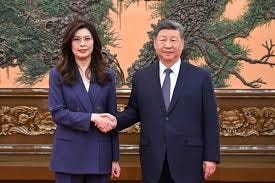
The recent meeting in Beijing between Xi Jinping and KMT Chairwoman Cheng Li-wun marks a significant recalibration of cross-strait optics, heavily influenced by the Trump factor and the shifting winds of American domestic politics. As the U.S. election cycle gains velocity, many nations are moving from a posture of high-trust cooperation to a strategic posture of high-fear hedging.
In this environment, the meeting serves as a pragmatic insurance policy. For political actors in Taiwan, maintaining a direct line of communication with Beijing is no longer just about ideology; it reflects the KMT’s calculated effort to ensure Taiwan is not left without a diplomatic exit should the Trump administration adopt a more isolationist foreign policy. This uncertainty is compounded by the volatility surrounding the upcoming Trump-Xi summit scheduled for May, a meeting delayed by the explosive escalation of the Iran conflict.
A Fragmenting Global Context
The broader global context reinforces this move toward a more conditional geostrategy. The ongoing war in the Middle East has disrupted the global energy architecture, forcing leaders to prioritize immediate stability over long-term alliances.
Simultaneously, the recent landslide victory of the opposition Tisza party in Hungary’s elections signals a potential removal of a key pro-Russia veto, while also introducing new variables into how the EU manages its collective security.
In this fragmented landscape, the Xi-Cheng meeting signals that traditional geopolitical guardrails are loosening. Leaders are increasingly forced to operate in a state of mobilization, where the risk of a “bolt from the blue” nuclear escalation, whether in Iran or via a sudden policy pivot in Washington, demands a more flexible and multi-directional foreign policy.
❝ Maintaining a line to Beijing is no longer ideological—it is strategic insurance.
A Muted Reaction in Taiwan
While the meeting captured international headlines, the global press remains hot on this report. International media have largely interpreted Beijing’s invitation as a strategic attempt to bypass the official government and engage with opposition leader who adhere to the 1992 Consensus. Much of this coverage has focused on the timing of the event, with many analysts viewing it as a calculated move ahead of the Xi-Trump summit to signal Beijing’s preferred framework for regional stability.
For its part, the KMT continues to stress that this was a vital peace mission. Party leadership has framed the dialogue as a necessary step to lower the temperature across the strait and maintain open lines of communication that the current administration cannot access. Notably, Beijing’s Taiwan Affairs Office (TAO) underscored that the KMT initiated the encounter, revealing that Chairperson Cheng Li-wun had expressed her willingness to visit Beijing multiple times to foster “goodwill and sincerity.”
For the average citizen, the event was met with a distinct sense of apathy—a neutral “don’t care” attitude that lacks the visceral “anti-China” sentiment or public backlash the DPP might have hoped to galvanize. This indifference stands in sharp contrast to the historic performance of the domestic economy. As the Taiwan stock market hits all-time highs, it has solidified its position as the 7th largest stock market in the world by volume. This financial boom has created a sense of security that makes political gestures feel increasingly disconnected from daily life.
Furthermore, public perception may be influenced by China’s shifting role on the global stage. In recent months, Beijing has positioned itself as a stabilizer in the Iran conflict, through Pakistan helping to broker the fragile April ceasefire. This diplomatic pivot has been mirrored by a flurry of Western leaders, including the UK Prime Minister, the German Chancellor, Canadian Prime Minister and most recently Prime Minister of Spain, traveling to Beijing to seek pragmatic cooperation all in past months. To some observers in Taiwan, if the West is engaging with China to manage global instability, the KMT’s “peace mission” appears less like an outlier and more like a reflection of a broader international trend.
The Ten Measures to Benefit Taiwan (十項惠台措施) were announced on the final day of the visit, targeting specific sectors like tourism and fisheries. These measures include plans to resume individual travel (自由行) for residents of Shanghai and Fujian, push for the “full normalization” of direct passenger flights, and streamline access for Taiwanese agricultural and fishery products.
However, because the DPP government has not yet accepted these measures, characterizing them through the Mainland Affairs Council as “unilateral concessions” and “sugar-coated poison” lacking institutional guarantees, their actual impact remains to be seen. As the administration continues to emphasize that any cross-strait matters involving public authority must be negotiated between governments, the implementation of these policies on the ground is currently at a standstill.
Cheng’s Political Positioning
Domestically, the sentiment surrounding the meeting has effectively solidified Cheng Li-wen’s position as a heavyweight within the KMT. By securing an audience in the Great Hall of the People, the first for a sitting KMT chair in a decade, she has signaled to both her party and the public that she is Beijing’s preferred interlocutor.
This “blessing” positions her as a leader capable of managing the most volatile aspect of Taiwan’s security, yet it remains a double-edged sword. While it bolsters her credentials among the “Deep Blue” base, the challenge will be translating this institutional recognition into broader voter trust without appearing overly aligned with Beijing’s long-term political agenda.
The Washington Test
The true test of this new hedging strategy will come in June, when Cheng is scheduled to travel to the United States. This upcoming trip to Washington is a deliberate effort to rebalance the narrative and reassure American policymakers that her engagement with China does not equate to an abandonment of the U.S.-Taiwan alliance.
By framing her message around the avoidance of a Cold War 2.0 and the necessity of dialogue, Cheng is attempting to position herself as a leader who can navigate the great productivity divide and communicate effectively with both superpowers. Success in this era will depend on whether such leaders can maintain this delicate equilibrium while navigating the systemic pressures of a world increasingly defined by strategic anxiety and high-fear globalization.
Rumors in Taipei suggest this rebalancing act is already yielding legislative fruit, as the long-standing impasse over the massive NT$1.25 trillion defense package appears to be nearing a resolution. While there is broad consensus on the Foreign Military Sales (FMS) portion to satisfy Washington and the Asymmetric/T-Dome initiatives to modernize defenses, the Domestic Production (Indigenous Defense) component remains the final point in question.
The KMT has indicated support for an NT$800 billion package but is reportedly holding firm on the demand that the domestic portion be integrated into the annual general budget rather than a multi-year special budget. This shift is intended to ensure greater legislative oversight and fiscal transparency for indigenous programs. The passing of this now depends on whether the DPP government will budge on these structural budget demands to secure the overall funding, and whether leaders can maintain this delicate equilibrium while navigating the systemic pressures of a world increasingly defined by strategic anxiety and high-fear globalization.
Eric Huang

Eric Huang. is an expert in US-China-Taiwan geopolitics, strategic planning, and crisis communication. He works at the intersection of policy and technology, helping organizations anticipate risks and seize op…